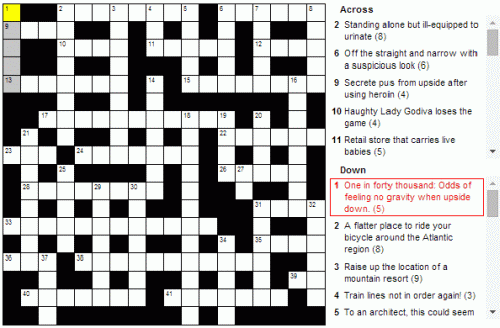
So it turns out that if you take a notion to create a crossword puzzle, put it on your blog, and include a “submit” button so that solvers can send you their answers, then — at least if your skill set is similar to mine — writing the code to make that “submit” button work will be about twice as difficult and three times as time-consuming (but perhaps also several times as educational) as actually creating the crossword puzzle. I certainly learned some hard lessons about the difference between POST and GET. But it’s done and (I think) it works.
To do the puzzle online click here. For a printable version, click here. If you do this on line and want to submit your answer, use the spiffy “Submit” button! (And do feel free to compliment the author of that button!). The clues are subject to pretty much the same rules that you’d find in, say, the London Times or the Guardian.
I will gather the submissions and eventually give proper public credit to the most accurate and fastest solvers. Feel free to submit partial solutions; it’s not impossible that nobody will solve the whole thing.
Let’s try to keep spoilers out of the comments, at least for a week or so.
I have one very geeky addendum to all this, leading to a second Monday puzzle — one that might be easy to solve for a reader or two, but most definitely not for me. Unless you’re a very particular brand of geek, you’ll probably want to stop reading right here. But:
Continue reading ‘Monday Puzzles’