The Dream Ticket

She hasn’t asked me, but I know who Hilary Clinton should choose as a running mate.

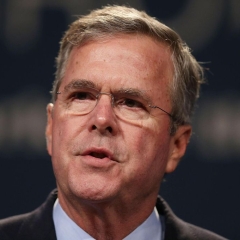
She should choose Jeb Bush. Then she should immediately issue this statement:

There’s a lot that Governor Bush and I disagree on. But we agree without reservation on the one thing that matters above all else this year, namely: Donald Trump must never be president of the United States. That matters more than any of our differences.

In the next few weeks, we’ll be issuing a package of policy proposals that represent compromises between my views and Governor Bush’s. None of these proposals will be exactly what either of us would have written on our own, and none of them will fully satisfy either my supporters or his. But we are confident that all reasonable adults will agree that, taken as a package, our proposals are infinitely superior to subjecting our futures to the whims of a sociopathic narcissist.

We will not attempt to deny or disguise our fundamental disagreements. Within the administration there will be lively debates. Governor Bush will always have a seat at the table and I’ll listen to his arguments — and then, as President, I will make the final calls. But I pledge to you that when I make those calls, I will be bound by the spirit of the policy package we will soon release.

Two years from now and four years from now, there will be national elections again. Governor Bush and I expect to be active in those elections, campaigning for very different candidates and making our cases to the American people for our very different visions. But we intend to speak to the American people as adults, and make our cases based on reasoned analysis, not base appeals to emotion.

We realize that many Americans — indeed, most Americans — will be dissatisfied with this ticket. There will be plenty of opportunities for you to express that dissatisfaction. If you prefer my philosophy to Governor Bush’s, then vote for us, and vote for the congressional candidates who you think will support my philosophy. If you prefer Governor Bush’s to mine, then vote for us, and vote for the congressional candidates who you think will support his philosophy. But for the sake of everything that matters in this election, do not vote for Donald Trump.

Here in the United States, we have enjoyed levels of freedom and prosperity so extraordinary that sometimes we have to be reminded not to take them for granted. Freedom and prosperity are fragile things, and can vanish in an instant. Governor Bush and I frequently disagree on how best to preserve our freedom and prosperity, but we fully agree that they are threatened as never before by Donald Trump.

One more thing: I will not be debating Donald Trump. His performance in the Republican primary debates confirms that he has no interest in anything that could reasonably be called a debate. As far as I can tell, all he wants is an audience for his temper tantrums. I will not help him procure that audience.

But issues should be debated, and presidential campaigns are the right time to debate them. Therefore Governor Bush and I are scheduling three debates, where I will make the case for a Democratic congress and he will make the case for a Republican congress. We aim to show the American people what a reasoned debate can look like, to be honest about our differences, and to show the American people that those differences pale beside the imperative need to rescue our republic from a vandal with the intellectual, emotional and moral sensibilities of a three year old.

Join us.

Almost all the Republicans I know are desperately trying to convince themselves that it’s okay to vote for Hilary this year, but just can’t quite make the leap. (And those who have made the leap tend to leap back every time they hear her speak.) The Clinton/Bush ticket would, I expect, pull in just about all of those Republicans. That should be good enough for a landslide.

Print Friendly, PDF & Email
Share

128 Responses to “The Dream Ticket”


  1. 1 1 Bob Murphy

    BTW why are you guys spelling it “Hilary”? It’s Hilary Swank, and Hilary Duff, but it’s Hillary Clinton.

  2. 2 2 Ken B

    I must object to 98 para 1. Mussolini was a murderer, who incited violence against his opponents. The comparison is invidious. It is especially objectionable considering the violence we have seen against Trump supporters, but not by them.

  3. 3 3 Advo

    @SSA 84:

    You are too kind. I wouldn’t claim that you are intellectually superior to Cruz, but it is clear that you are a great deal more intelligent than you consider Cruz to be. Being able to argue with you, without resorting to name-calling or insult, has been a pleasure.

    Thank you :)
    And let me return that compliment. It is a rare pleasure to have such a discussion with someone. The best thing, to be honest, is that there’s so many obviously irrelevant counterarguments you DON’T make. Usually I have to explain my arguments in extremely fine detail…and even then, it hardly ever sticks…
    You tend think a few steps ahead, and you make valid counterpoints I hadn’t thought of. I’m so unused to that :)
    It’s not only you, of course, this blog and this forum are something of a rarity on the internet.

    But what does that say about politicians, like Ms. Clinton, who endorse minimum-wage or rent-control laws? Surely the economic case against price controls is vastly stronger and simpler than the case against the gold standard.

    1. As to rent-control, I’ve googled for Clinton and “rent-control” and had absolutely no luck finding anything. Only one vague allusion on some blog somewhere. Do you know what she said in that regard specifically?
    While rent-control is generally deeply stupid, there is at least one form that makes sense – you can limit rent increases on new leases after year 1 for a few years, so that a tenant has the certainty that the rent on his new lease won’t suddenly start going up by double digits after year 1. This very limited form of rent-control improves market transparency.

    2. As to the minimum wage, I AM A GREAT FAN OF IT. Within reason, of course. Minimum wage laws appear to have only negligible impact on employment and I believe that they substantially add to overall utility, i.e. the costs they inflict on the employer are lower than the benefit they bring to the employee. A lot of the wage gain is actually a free lunch. Also, raising the minimum wage drives productivity improvements.
    Here’s a good study on the topic:

    http://cepr.net/documents/publications/min-wage-2013-02.pdf

    3. What Hillary thinks or knows about economics is far less important than what Cruz thinks and knows about economics.
    Why? Because Hillary doesn’t want to fundamentally overturn economic policy in the US, whereas Cruz does.
    Here’s Hillary’s economic plan:

    https://www.hillaryclinton.com/issues/plan-raise-american-incomes/

    I think you’ll agree that none of these policy proposals will melt down the US economy. It’s all tinkering around the edges, and so Hillary’s economic expertise or lack thereof isn’t THAT important.

    But what about Cruz? He wants to abolish various government departments outright and comprehensively deregulate the economy. But as we discussed above at the example of the pharmaceutical industry and the patent industry, deregulation doesn’t necessarily lead to good outcomes (to put it mildly). And if Cruz doesn’t know what he’s doing, you can bet that things will go badly.

    The most important example is, of course, financial deregulation.
    Cruz wants to deregulate Wall Street and prevent any bailouts. From historic experience, the typical outcome of financial deregulation is a financial meltdown. For details, read Reinhart/Rogoff “This Time is Different”.
    I’m sure you could carefully deregulate Wall Street – or rather, regulate it differently than how it is currently regulated. I’m partial to the idea of attaching personal liability to the executives of financial institutions, for example. I’m sure you have your own ideas, you wouldn’t just deregulate and see what happens…right? Before you tell me that’s exactly what you would like to do, please read Reinhart/Rogoff and see what you think then.

    Cruz doesn’t understand economic history, and he doesn’t understand economics. It’s not only the thing with the gold standard, it’s also the simple fact that he hasn’t given any indication that he understands the grave risks involved with financial sector deregulation and he hasn’t said anything about what kind of regulatory regime he would put in place of the existing one. I guess he wouldn’t replace it with anything.
    At least that’s what you have to assume. You can’t just HOPE that he has a clue and a plan, because if you’re wrong, then the likely outcome will be cumulative losses in economic output in the tens of trillions of dollars over the next twenty years.
    That’s not hyperbole, that’s merely saying that this time will not be different.

    I’m sure Cruz is a brilliant lawyer, but he obviously doesn’t know economics and he appears to be incapable of learning it due to his ideological conviction (fanaticism).

  4. 4 4 Advo

    To elaborate on rent control:
    Rent control (or, as it is preferably called in this context, “rent regulation”) can be beneficial if you set the price cap AT OR ABOVE the market rent.
    But what sense would that make?
    It works like this:
    Once the tenant has moved in, he has incurred substantial sunk costs. Looking for an apartment is time-intensive and annoying. Moving is expensive. In many ways, moving is also somewhat traumatic if you’re used to your home.
    An unscrupulous landlord can leverage your “sunk costs” and your emotional attachment to raise the rent above market level.
    Of course it’s possible to impose contractual limits on rent increases. But that has two problems: 1. it may not be done even if it makes sense 2. this will prevent the rent from adjusting in line with the market.

    A government-imposed cap on rent increases in line with the development of the overall market can thus lead to a better outcome by preventing abuses while allowing market price adjustments.

  5. 5 5 nobody.really

    Why would people on this libertarian-ish web site identify Clinton/Bush as the dream ticket—when you could be voting Libertarian: Johnson/Weld!

    Come on, say it with me: “Feel the Johnson!

    (…you know you want to.…)

  6. 6 6 iceman

    Advo – “A government-imposed cap on rent increases in line with the development of the overall market”

    My circularity alarm is going off. The more binding your cap is, the more it will shape the “market” trend.
    To say nothing of the trust you’re placing in bureaucrats to make all of the idiosyncratic adjustments for particular properties.
    Sure moving is no fun, but at some point we have to treat people like adults…or the argument for the paternalistic state becomes self-fulfilling.

    This ties in with the main problem I see with your general faith in regulation (see #45): comparing alleged real-world failings of ‘markets’ (people) with an idealized vision of govt. (people). Often this seems based on what I call the fallacy of omniscience, strangely used by people who tend to dismiss the ideas of objective truth and perfect information in other areas.

    I’m generally a big fan of informing people…and then letting them make choices.
    It would be great if regulations could go further and prevent problems ex ante, but all-knowing, objective (e.g. non-captured) regulators are the analogue of the hyper-rational homo economicus.
    If our knowledge is constantly evolving (often flip-flopping, even in seemingly mundane areas like nutrition), who’s to say for sure that someone can’t benefit from something? (As I think SSA mentioned, even psychological benefits have utility.)
    Meanwhile admitting fallibility means we need to consider the potential for the air of authority to create a false sense of security (this applies to financial markets in spades as well).

    Fraud isn’t a market failure either, it’s a crime, and as with pollution, the optimum level is probably not zero – which isn’t achievable anyway with or without regulations.
    And if (as is my guess) regulators are usually reacting to events, the legal system does that too…so is the advantage of regulations that they reduce friction costs? If this is equivalent to saying they indemnify companies (“hey I was in compliance”), that may be a perverse incentive.
    And we’ve already discussed the risk-averse bureaucratic incentive – I would think much more often the benefits aren’t crystal clear and, perhaps more importantly, visible to the public.
    And…I gotta go, enjoying this thread

  7. 7 7 Advo

    Iceman:
    My circularity alarm is going off. The more binding your cap is, the more it will shape the “market” trend.
    To say nothing of the trust you’re placing in bureaucrats to make all of the idiosyncratic adjustments for particular properties.

    I don’t suppose I expressed myself clearly: The idea is to establish the average market rent per sqm for the year for a certain area based on new rental contracts and subtract the average market rent for the previous year. You can do some quality adjustments e.g. for the age of the units.
    This % difference would then limit increases on existing leases.
    No cap is imposed on new leases.
    I’m not really very engaged with this concept, I haven’t looked into this topic too much. My point was that there are forms of rent control which are at least defensible and not a priori idiotic like the first generation rent control mechanisms which in their effect often resembled a slow-motion carpet bombing of an area.

    Often this seems based on what I call the fallacy of omniscience, strangely used by people who tend to dismiss the ideas of objective truth and perfect information in other areas.

    I’m generally a big fan of informing people…and then letting them make choices.

    It’s not so much that I believe that the government is omniscient in absolute terms, it’s that it tends to be so much better informed than the average consumer, and that for a consumer, the cost of becoming informed is very often prohibitive.
    A good example is Landsburg’s lifeboats for the Titanic post from a few years ago (it dealt with the question whether or not the expense of having sufficient lifeboats to carry all passengers was worth it). If you look at the numbers, you’ll find that the cost a prospective passenger incurs when he even just THINKS about whether or not he would prefer a lifeboat or a lower ticket price is MUCH higher than the (pro-rated) cost of the actual lifeboat (even ignoring the fact that Landsburg drastically underestimated just how well creosote/carbolineum preserve wood).

    http://www.thebigquestions.com/2012/04/16/lifeboats-on-the-titanic/

    And this is just one tiny little problem. Consider the complexity of the modern economy and just how many of such problems you’d potentially be faced with on a daily basis in a libertarian economy, or even in a substantially deregulated economy a lá Cruz.

    It would be great if regulations could go further and prevent problems ex ante, but all-knowing, objective (e.g. non-captured) regulators are the analogue of the hyper-rational homo economicus.

    I suppose if the biggest failing of conservatives is their underestimation/ignorance of information problems, the liberals’ failing is ignoring (in their policy ideas) the issue of regulatory capture.
    That said, I’d argue that the problem of regulatory capture, as it presents itself in the US, is largely due to the system of campaign financing, which amounts to institutionalized corruption, as well as the anti-government crusade of the right wing, which seems to be designed to demoralize and wreck all government institutions, then put them to work for the GOP’s donor base. The GOP establishment seems to regard regulatory capture as a positive policy goal, rather than as a problem to be avoided.
    I don’t think that most other developed nations face anywhere near the level of problems with regard to this issue that you find in the US.

  8. 8 8 Advo

    In the presence of systemic regulatory capture such as you face in the US, deregulation isn’t a panacea, because of course this deregulation will then go very much the way special interests want, so you potentially end up with a substantially worse regulatory regimen than you had in the first place.

  9. 9 9 Advo

    Texas governor Abbott self-mutilates to avoid Trump convention; is that cowardice or bravery?

    http://www.foxnews.com/politics/2016/07/13/texas-gov-abbott-to-miss-republican-convention-after-suffering-severe-burns.html

  10. 10 10 iceman

    Dark humor…105 was funny tho

    “[Govt] tends to be so much better informed than the average consumer…consider the complexity of the modern economy”

    Isn’t this the thinking that led people to believe input-output tables could supersede the price system? The point there is that not even a team of learned experts (whose other incentives and motivations we’ll assume are pure and objective) can hope to process the information contained in the hundreds / thousands / millions of interactions (views, opinions, expectations, knowledge of unique circumstances) that constitute a price? Part of this may be that there is no “average” consumer.
    I would argue in this context greater complexity only makes the task more futile for the bureaucrats.
    However, again where they can play a helpful role by adding information to the process, by all means…

    Interestingly, speaking of the Titanic this appears to be an excellent example of the false sense of regulatory security I mentioned, as someone posted:
    “Yet the Titanic was fully compliant with all marine laws. The British Board of Trade required all vessels above 10,000 metric
    tonnes (11,023 U.S. tons) to carry 16 lifeboats. The White Star Line ensured that the Titanic exceeded the requirements by four
    boats. But the ship was 46,328 tonnes. The Board of Trade hadn’t updated its regulations for nearly 20 years.”
    Perhaps beside your point but as some alluded to, what I think the premise of that post was missing was that it was reasonably expected that the ship would be travelling in areas where marine traffic was sufficient that everyone was effectively guaranteed a seat on a lifeboat.

  11. 11 11 Advo

    Isn’t this the thinking that led people to believe input-output tables could supersede the price system? The point there is that not even a team of learned experts (whose other incentives and motivations we’ll assume are pure and objective) can hope to process the information contained in the hundreds / thousands / millions of interactions (views, opinions, expectations, knowledge of unique circumstances) that constitute a price? Part of this may be that there is no “average” consumer.

    The Titanic lifeboat information problem is kind of the opposite of the social calculation problem.
    In the social calculation problem, the government seeks to supersede the guy with the information, the seller. In the Titanic information problem, the government seeks to supersede the buyer, i.e. the guy who doesn’t have the information.
    In the former case, the government is less effective/efficient because it is at an information disadvantage; in the latter case, the government is at an information advantage, because it has means to get the information that the buyer doesn’t have, and of course if a multitude of buyers has to procure and process the same information that’s much less efficient than if the government does it once.
    You are of course right that in some cases the buyer will have some information that the government doesn’t have.
    In the Titanic example the only scenario where that would be the case is if the buyer was suicidal, I guess, or possibly a fish or a walrus or something. (This may sound really silly, but is intended to illuminate the point you alluded to).
    I understand that the one-size-fits-all approach that government must necessarily take in many circumstances can lead to substantial inefficiences.
    But I believe that this kind of thing is a small price to pay, because I am fairly certain that the economy overall would be far smaller and we’d all be much poorer without the existing comprehensive regulatory regime freeing us from the gigantic information costs we would otherwise incur.

  12. 12 12 nobody.really

    American Univerity’s Joseph Young comes out in favor of a Unity Ticket.

    [A] Unity Ticket is revolutionary in that it upends the standard operating procedures in Washington. But isn’t that what voters want? Isn’t that what America needs?

    After all, would Clinton/Kasich slow Washington down further? Would Clinton/Rice make the world more dangerous? For that matter, imagine for a moment a Clinton/Ryan ticket.

  13. 13 13 iceman

    111 – remind me again how we ever figure out what the price of an unregulated apple should be? Or maybe I shouldn’t buy any at any price because if my ship sinks tomorrow they’ll all just rot in my fridge. What to do? I can’t decide.

    Partly kidding – I agree there’s a case for regulation where there are large asymmetries with severe risks. But your rhetoric seems to over-generalize the case, and perhaps even overstate the benefits where regulation is justified.
    Food might actually be the best example I can think of: while the buyers can’t know if a restaurant is taking proper precautions, they do know the seller has a strong incentive to avoid an outbreak of food poisoning since reputational damage and/or lawsuits could destroy them.
    So maybe at best well-designed regulations prevent a single incident, since once something happens the information is out there for everyone to react to, regulators included.
    And from there it seems we’re in your social calculation mode — the seller likely has better knowledge of what are reasonable measures for their situation, defined as offering more risk reduction than they cost.
    In which case all the bureaucrat can add is mandating things that cost the seller — and therefore the buyers — more than they’re worth.
    I’d imagine the counter-argument would have to have something to do with the idea that there are sellers out there who want to start restaurants cheaply, roll the dice, walk away and start over somewhere else.
    Again I think this reflects a general under-appreciation of the role reputational value plays in market economies.

  14. 14 14 Advo

    Food might actually be the best example I can think of: while the buyers can’t know if a restaurant is taking proper precautions, they do know the seller has a strong incentive to avoid an outbreak of food poisoning since reputational damage and/or lawsuits could destroy them.

    Iceman, it seems to me that you haven’t spent a lot of time living in a developing nation. I live in the Philippines, and let me tell you, it doesn’t seem to work like that in practice. Why do you think the food and restaurant industries in the US got subjected to so much government oversight in the first place?
    I’ll elaborate some more on the topic later today.
    Here’s a video from when I used to live on Boracay:

  15. 15 15 Advo

    Here’s how food safety works in reality:

    You develop food poisoning.
    How do you know who to sue? Was it the tap water? The restaurant you went to yesterday? This morning’s sausage? Yesterday’s yogurt? Did you just handle your food wrong?
    I have been sensitized to the problem of food safety since I moved to the Philippines and I realize now just how impossible it is to find out what caused a rash or diarrhea (the latter of which occur MUCH more frequently than in Europe).
    And that is relatively straight forward.
    Consider that there are a great many chemicals and substances that will cause damage only after prolonged exposure or years or decades after exposure.
    Imagine you get cancer. How do you know it was caused by the coloring in the sausage you used to eat frequently ten years ago? How do you know it wasn’t the fact that your favorite restaurant had a massive mold problem in its kitchen? Or that your drywall is exuding carcinogenic fumes?

    The reason why every single Western country has food safety regulation and supervision is not the employment of otherwise unemployed bureaucrats. The reason is that without government supervision and enforcement, food safety sucks.

    Just consider this simple question next time you’re in a restaurant:
    Given that you have no way of finding out, what kind of cooking oil is the restaurant probably going to use, heart-healthy extra virgin olive oil that costs two cents extra or cheap crap loaded with unhealthy transfats?

  16. 16 16 nobody.really

    The GOP finally crushes the #NeverTrump movement, and Trump has named a VP. As a result:

    • If you go to the GOP Convention, you will hear Trump/Pence sound.
    • In their more genteel moments, they may serve tea and Trump/Pence.
    • And since self-destruction seems to be the GOP’s dearest wish, come Election Day, come hell or high water, they will get the come-Trump/Pence they so richly deserve.

  17. 17 17 iceman

    I suppose it’ll cost a thruppence to go see Trump-Pence?

    Advo – I understand, what I meant was food safety is the best example I could think of for where regulation is justified. And yes I have more developed countries in mind. But here’s also how it generally works in the real world: A single person doesn’t come down with food poisoning, enough people do that we can often trace to common factors like they all ate at the same place. Even a huge chain like say Chipotle, which has been paying a steep price. And of course in underdeveloped countries lost jobs and higher prices from overly burdensome regulations are that much more costly to real people.

  18. 18 18 Advo

    Advo – I understand, what I meant was food safety is the best example I could think of for where regulation is justified.

    Ah. Because what you said sounded like the opposite.

    that we can often trace to common factors like they all ate at the same place.

    Who is this “we” who does the tracing?

    Here’s an even better example for information asymmetry – radiation from imaging. The patient doesn’t know and the service-provider doesn’t give a s+++.

    https://www.washingtonpost.com/national/health-science/how-much-to-worry-about-the-radiation-from-ct-scans/2016/01/04/8dfb80cc-8a30-11e5-be39-0034bb576eee_story.html

    “There’s no standardization of how these exams get conducted,” Smith-Bindman said. “There’s no oversight and no one’s responsible for this.”

    Recently, she said, she spoke to a group of 300 radiology technologists and was “dumbfounded” by their questions. One asked her, “How do I pick a dose?” The technologist said she had devised her facility’s CT protocol, a job that is supposed to be performed by radiologists. Another said that in her hospital, “no one cares” about radiation doses.

  19. 19 19 nobody.really

    For your pre-convention reading pleasure, here’s an excerpt from ABC News’s ongoing series, DIVIDED AMERICA: To Some, Trump Is a Desperate Survival Bid:

    The population of Logan County [West Virginia] is … half what it was 50 years ago. [O]ne in five lives in poverty; few have college degrees. Drug abuse is rampant. [Men] die eight years younger than the average American man.

    Even cremations are up at the funeral home down the street. People can’t afford caskets anymore….

    The unemployment rate is 11 percent, compared to less than 5 percent nationwide. Many have given up working altogether: West Virginia is the only state in America where less than half of working-aged people work. More than 12 percent of Logan County residents collect Social Security disability checks, three times the national average.

    They gave up on their politicians — they elected both Republicans and Democrats and believe both failed them in favor of chasing campaign contributions from the class above them and votes from the one below, the neighbors they suspect would rather collect government welfare than get a job.

    Anxiety turned to despair…. And desperate people, throughout history, have turned to tough-talking populists….

    “[Trump] offers us hope … and hope’s the one thing we have left.”
    * * *
    “[N]ostalgia voters…” [see] an uneven recovery from the recession lined up with societal shifts — the election of the first non-white president, a rising minority population, the decreasing influence of Christian values. It left many in struggling, blue-collar communities across the country feeling deserted for the sake of progress someplace else.

    “Today, we’re not interested in the plan, we’re interested in the slogan…. When confidence falls, it’s all too complicated to understand an elaborate plan or an articulated policy. We don’t want to wait for the details; we don’t want to read the footnotes. Just give me a powerful headline.”
    * * *
    “I don’t know exactly what’s in [Trump’s] head, what his vision is for us…. But I know he has one and that’s what counts.”
    * * *
    People like Trump’s delivery, the rat-a-tat-tat of promises and insults so unscripted they figure he couldn’t have given it enough forethought to be pandering.
    * * *
    [These voters aren’t blind; they acknowledge Trump’s shortcomings, but are] willing to forgive because they believe the political machine left them with no other option.

  20. 20 20 iceman

    Pretty quiet out here.
    118 – sorry I was trying to say two things at once: food safety is the best case I can think of FOR regulation, AND even in that case the actual benefits are probably more modest than we might think. (Finding “tracers” is usually not a problem with an enterprising media…and lawyers…eventually govt officials.)

    The radiation thing seems like another valid example, although I’m guessing part of the reason it wouldn’t get more scrutiny is the actual level of risk – ironically, as assessed here by the FDA:

    “The probability for absorbed x-rays to induce cancer or heritable mutations leading to genetically associated diseases in offspring is thought to be very small for radiation doses of the magnitude that are associated with CT procedures…Under some rare circumstances of prolonged, high-dose exposure, x-rays can cause other adverse health effects…but at the exposure levels associated with most medical imaging procedures, including most CT procedures, these other adverse effects do not occur.”

    Perhaps you believe this is a case where the FDA is creating a false sense of security?

    Moreover my guess is the vast majority of people will likely never have a CT scan.
    So I guess I’m going to need more to persuade me the economy would be “far” smaller and we would all be “much” poorer without the existing comprehensive regulatory regime. Again it’s one thing to inform people (I’m generally a fan of that), but the main goal of much regulation appears to be reducing risk by PRECLUDING some economic activity. In that sense we can have stronger growth or less risk but perhaps best to strike the right balance rather than pretend we can have both.

  21. 21 21 iceman

    We need a new thread, nobody.really has been trying, I’ll try too:

    Today’s objectivity test: however you feel about Melania’s speech-lifting yesterday, did you feel the same about “Just Words” in 2008?

  22. 22 22 Advo

    So I guess I’m going to need more to persuade me the economy would be “far” smaller and we would all be “much” poorer without the existing comprehensive regulatory regime.

    A big problem – perhaps the biggest problem – of an unregulated economy is the financial markets, or rather the lack thereof.
    In countries where they are not heavily regulated and well-policed, capital markets are fraudulent and small – a similar phenomenon to the patent industry/dietary supplement sector.

    The lack of efficient capital markets alone would have condemned the US to 2nd or 3rd world status.

  23. 23 23 Advo

    Patent MEDICINE industry, obviously.

  24. 24 24 Advo

    Perhaps you believe this is a case where the FDA is creating a false sense of security?

    No. The risks of CT imaging ARE low.
    In the worst case, a CT scan will perhaps have a 1:500 chance of killing the patient (young woman, chest CT, high dosage).
    Mostly, the risk is much lower.
    HOWEVER, while the risks are relatively low, they are, on average, WAY higher than they should be, and that likely causes somewhere between a few thousand and a few tens of thousands of deaths per year.
    This is inefficient.

    I don’t think I’m properly communicating my larger point – this is about efficiency.
    This is one little bit of inefficiency. It is just an example for the kind of inefficient result you get in the absence of regulation.
    In the absence of government regulation, you would be exposed to a great deal more toxic chemicals not only through your food but through many of the products you daily come in contact with.
    Service providers would take advantage of you and many goods and services you bought would just be a crapshoot.

  25. 25 25 Advo

    @iceman:
    Basically, right-wingers make the mistake of looking at an example like the one with the CT scanners and see it as a unique problem, rather than as an example for a fundamental phenomenon which affects all economic activity.

    They make the same mistake when looking at financial crises, always looking for specific circumstances (in particular government policies) which shaped this or that particular crisis, failing (or not wanting) to understand that financial crises are an inevitable occurence in a competitive, dynamic financial system which has not been sufficiently hamstrung by the heavy hand of government (does that qualify as mixing metaphors?).

  26. 26 26 iceman

    I could agree with much of what you say, in theory – and in some cases, maybe govt regulators can actually provide just the right, efficient touch with their guiding hand.
    But a very good reason to take things case-by-case is that what proponents of govt seem to miss is that graft, corruption, coopting / creeping of missions, incentives skewed toward risk aversion, doing things for feel-good / sound-good reasons, and plain old incompetence / indifference are inherent and inevitable facets of the incentives that human bureaucrats face. All of that argues strongly against efficiency, which is not a word often used in association with govt, for good reason. At best unclear and seems like a tough case to make that regulations are a net plus for economic growth and efficiency. At the same time again it’s fine to say “but we need to protect people”. I also think you continue to under-estimate the role of reputational value in “free” commerce…”fool me once” is not a strategy that leads to a high stock price.

    BTW in my experience financial crises always have govt fingerprints all over them as well, but that’s a whole other topic.

  27. 27 27 Advo

    I also think you continue to under-estimate the role of reputational value in “free” commerce…”fool me once” is not a strategy that leads to a high stock price.

    Have you read “Reinventing the Bazaar”?
    It’s been a while since I read it, but I believe that it explains the limits of self-regulation quite well, or at least provides a lot of material showing those limits. I recall that it could have benefited from a bit more structure, but it was still a very good book.

    BTW in my experience financial crises always have govt fingerprints all over them as well,

    Of course they do.
    That is because the banks/shadow banks always seek to maximize their profits within the constraints of prevailing regulatory environment.
    And if that regulatory environment is insufficiently restrictive to prevent them from blowing themselves up, it will still substantially shape just how the banks go about it.
    In any industrialized economy, the government is intervening in every economic activity to some degree. It taxes, regulates liability, emissions, disclosure, it standardizes, builds or regulates infrastructure etc.
    Because of this, anything that goes wrong in the economy will have the government’s fingerprints on it somewhere, and if you want to, you can always conclude that the government caused the problem.
    Libertarians want to reach that conclusion very much and inevitably do.

    Many (you?)look at the specific way the financial sector blew itself up and conclude that, because that specific way was influenced by regulation and government intervention, that means regulation and other government intervention caused the banks to blow themselves up.
    That is not the case, however.
    The truth is that a dynamic and competitive banking system is ALWAYS evolving towards blow-up, as (during normal economic times) taking more risk leads to higher growth, and so the fools among the bankers have a competitive advantage until there are too many of them, which destabilizes the system and causes a blowup.

    This quasi-darwinian process, which works through organic growth of aggressive companies, promotion of greedy and myopic individuals through the hierarchy, adoption of greedy and myopic business plans and takeovers of conservative companies by more aggressive actors, is what drives the Financial Disaster Cycle.

  28. 28 28 iceman

    OK on to the whole other topic :)
    I confess it seems most times I dig a little deeper into “market” problems / failures I find govt fingerprints that made things worse, and sometimes were necessarily causal. Of course we have to be careful of finding what we’re looking for, and this applies to both sides: a more cynical (read: realistic) view of govt is that it’s in the business of needing problems to “fix”. You seem to have the opposite inclination to take a more charitable view of govt than of markets.
    Certainly the financial system is another case where most people would agree some regulation is necessary. And yet stepping back it sure seems like the risks have become more systemic over time; moral hazard grows with each bailout sowing the seeds for the next; easy money (in an endless quest for smoothing) has to flow somewhere; deposit insurance means no one cares where they put it. My reading of the S&L crisis is that it was rooted in anachronistic regulation (ceilings on deposit rates). Another interesting factoid I’ve read many times is that no Canadian banks went bust during the Depression, the main difference being they did not have our interstate banking restrictions.
    So to me it’s very much an open question which way our good regulatory intentions have led us on net over the long run.

    One thing I think everyone agrees on is IF we’re going to subsidize banks, we have to regulate them. The question is at what point should we go back and take a closer look at the IF part.

  1. 1 Steve Landsburg and I Disagree About Politics
Comments are currently closed.