The more specific your query, the deeper Google has to search to find “enough” results. The deeper it searches, the more accurate its estimate of the total number of results.
This is actually very bizarre. 10+ years ago, I heard on Nickelodeon that if the first words you say on a new month are ‘Rabbit Rabbit’ then you’ll have good luck for the whole month. I used to try from time-to-time, but I could never remember when I woke up to say ‘rabbit rabbit.’ I have never heard anyone else mention this luck-gaining technique. I was just thinking about it again last night, and I was up at midnight, so I made sure my first words of this month were ‘rabbit rabbit.’
It could be that that story was only interesting to me, but I’m ok with that.
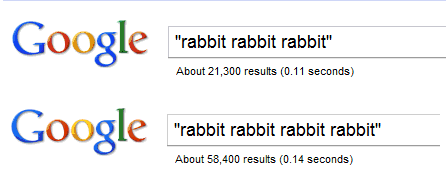
I did the search with 4 rabbits, and it told me there were “about 64,100” results. I followed the search clicking on the last page shown, and there were only 337 “hits”! There was a bit that said that some had been omitted because they were similar to above, so I searcehd with these included. Up to page 40 it said there were about 147,000 results, then suddenly on page 41 it ran out and there were only 410 results.
For “rabbit rabbit rabbit” it said there were about 20,100 results, but there were actually only 555
What is Google up to? How does it estimate this number, and does it mean anything?
Don’t confuse Google’s results with a simple “grep -c” or SQL query. Saying you want 4 rabbits is a lot more meaningful, to the algorithm, than just wanting 3.
What is frustrating to me is that putting something in quotes used to mean “exact match” but now “exact” means something that I don’t understand.
Tom Limoncelli: Yes, this is exactly what drives me crazy. In two different ways: First of all, I want my search engine to search for what I tell it to search for, not for what it thinks I probably wanted to search for. Second, they changed the rules in the middle of the game *without telling us*, so for a while I believed it was doing one thing while it was in fact doing another.
Apologies for another similar post. “rabbit rabbit rabbi” says it has 2890 results, and shows 3 pages at the bottom. Click on p2 and you get “p2 of 17 results”. How come it knows there are 17 results on p2, but thinks there are 2890 results on p1?
If you want something more strange, when you search for “rabbit rabbit rabbit rabbit” you get 73K plus change results, and you get the same approximate number no matter how many times you add rabbit in the quotes. I quit at 10.
There used to be a game called Google roulette where the objective was to enter a search string that yielded a unique result. Years ago it was possible, but I guess that must be hard to do now.
“I want my search engine to search for what I tell it to search for, not for what it thinks I probably wanted to search for.”
If Google did so, then it would be acting (in the sense that I think you usually mean it) irrationally. In particular, it would be catering to the preferences of a small minority in the face of overwhelming evidence that people generally want the opposite.
For example if I search for “redshoes” Google very smartly searches for “red shoes”; my actual input can be retrieved by another click but in fact I was looking for red shoes and just mistyped it. Given the vast array of nearly correct inputs that people make, why should Google behave in the way you say you want it to?
“Given the vast array of nearly correct inputs that people make, why should Google behave in the way you say you want it to?”
I thought the point of using qoutes was to tell Google that this is exactly what you are looking for. If you want some help with your search, you can leave off the qoutes.
Neil: if you look further at the results, it says you get 73K rewsults for each, but if you look to the end, you actually get:
6Rabbits: 129, 7R = 85, 9R = 52, 14R = 26.
Every hit seems to include the required number of “Rabbits” consecutively. They are sometimes separated by punctuation, but we know Google ignores these. So Google does seem to be searching for the exact phrase, or is it the punctuation that you want it to include?
If I search for “rabbit rabbit rabbit rabbit” when signed into Google, I get “about 147,000 results”, if I do it when not signed in, I get “about 64,200 results” (this numbers have been checked in three different browsers at a few different times).
As has already been pointed out, David Sloan’s explanation for this behaviour is just wrong – 64,200 is already an overestimate, so 147,000 is certainly not “more accurate”. Does anyone have any idea what is going on here?
Yes, you are right. It is the omitted results that are keeping the tally even after four rabbits. Those omitted results must include a variable number of rabbits.
Interesting, though, that Steve’s 3 rabbits seems to be a local minimum. You get more hits with two rabbits or four.




The more specific your query, the deeper Google has to search to find “enough” results. The deeper it searches, the more accurate its estimate of the total number of results.
Why were you searching for “rabbit rabbit rabbit” or “rabbit rabbit rabbit rabbit”?
Don’t you hate when journalists use number of hits to make a point about popularity or something?
This is actually very bizarre. 10+ years ago, I heard on Nickelodeon that if the first words you say on a new month are ‘Rabbit Rabbit’ then you’ll have good luck for the whole month. I used to try from time-to-time, but I could never remember when I woke up to say ‘rabbit rabbit.’ I have never heard anyone else mention this luck-gaining technique. I was just thinking about it again last night, and I was up at midnight, so I made sure my first words of this month were ‘rabbit rabbit.’
It could be that that story was only interesting to me, but I’m ok with that.
I did the search with 4 rabbits, and it told me there were “about 64,100” results. I followed the search clicking on the last page shown, and there were only 337 “hits”! There was a bit that said that some had been omitted because they were similar to above, so I searcehd with these included. Up to page 40 it said there were about 147,000 results, then suddenly on page 41 it ran out and there were only 410 results.
For “rabbit rabbit rabbit” it said there were about 20,100 results, but there were actually only 555
What is Google up to? How does it estimate this number, and does it mean anything?
Another quick result:
“bose einstein condensate” says about 110,000 results, but runs out after 489, or 960 with the “similar results” included”
“bose einstien condensate” (note mis-spelling) says about 1320 results, but runs out after 230
Hal Varian must be spinning in his grave!
Don’t confuse Google’s results with a simple “grep -c” or SQL query. Saying you want 4 rabbits is a lot more meaningful, to the algorithm, than just wanting 3.
What is frustrating to me is that putting something in quotes used to mean “exact match” but now “exact” means something that I don’t understand.
@ Super-Fly:
I remember that! I used to do that too, and I neve remembered to say it either!
That’s nothing. “badger badger badger” gives 63,400 results.
Tom Limoncelli: Yes, this is exactly what drives me crazy. In two different ways: First of all, I want my search engine to search for what I tell it to search for, not for what it thinks I probably wanted to search for. Second, they changed the rules in the middle of the game *without telling us*, so for a while I believed it was doing one thing while it was in fact doing another.
You don’t have to use Google.
Apologies for another similar post. “rabbit rabbit rabbi” says it has 2890 results, and shows 3 pages at the bottom. Click on p2 and you get “p2 of 17 results”. How come it knows there are 17 results on p2, but thinks there are 2890 results on p1?
If you want something more strange, when you search for “rabbit rabbit rabbit rabbit” you get 73K plus change results, and you get the same approximate number no matter how many times you add rabbit in the quotes. I quit at 10.
There used to be a game called Google roulette where the objective was to enter a search string that yielded a unique result. Years ago it was possible, but I guess that must be hard to do now.
“I want my search engine to search for what I tell it to search for, not for what it thinks I probably wanted to search for.”
If Google did so, then it would be acting (in the sense that I think you usually mean it) irrationally. In particular, it would be catering to the preferences of a small minority in the face of overwhelming evidence that people generally want the opposite.
For example if I search for “redshoes” Google very smartly searches for “red shoes”; my actual input can be retrieved by another click but in fact I was looking for red shoes and just mistyped it. Given the vast array of nearly correct inputs that people make, why should Google behave in the way you say you want it to?
“Given the vast array of nearly correct inputs that people make, why should Google behave in the way you say you want it to?”
I thought the point of using qoutes was to tell Google that this is exactly what you are looking for. If you want some help with your search, you can leave off the qoutes.
@Alan Wexelblat: “Given the vast array of nearly correct inputs that people make, why should Google behave in the way you say you want it to?”
Because you ask it to, when you put quotation marks around the phrase; and because it says it will, in the advanced search options and elsewhere.
Neil: if you look further at the results, it says you get 73K rewsults for each, but if you look to the end, you actually get:
6Rabbits: 129, 7R = 85, 9R = 52, 14R = 26.
Every hit seems to include the required number of “Rabbits” consecutively. They are sometimes separated by punctuation, but we know Google ignores these. So Google does seem to be searching for the exact phrase, or is it the punctuation that you want it to include?
If I search for “rabbit rabbit rabbit rabbit” when signed into Google, I get “about 147,000 results”, if I do it when not signed in, I get “about 64,200 results” (this numbers have been checked in three different browsers at a few different times).
As has already been pointed out, David Sloan’s explanation for this behaviour is just wrong – 64,200 is already an overestimate, so 147,000 is certainly not “more accurate”. Does anyone have any idea what is going on here?
Harold,
Yes, you are right. It is the omitted results that are keeping the tally even after four rabbits. Those omitted results must include a variable number of rabbits.
Interesting, though, that Steve’s 3 rabbits seems to be a local minimum. You get more hits with two rabbits or four.
Correction–excluding omitted results, the number of hits declines monotonically with the number of rabbits.