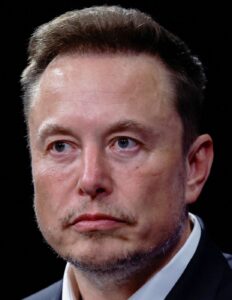
 The number $2800 has been popping up in a lot of my Internet feeds lately. That, allegedly is the amount by which Elon Musk could enrich every American if he gave his trillion dollars away. I conclude that a lot of people on the Internet are very bad at arithmetic.
Apparently what these people have done is to take a trillion dollars and divide it by 350 million Americans. That’s the wrong calculation. Here’s why:
I doubt very much that Mr. Musk plans to spend a trillion dollars before he dies. Suppose instead that he plans to spend, say, a hundred million. Now suppose he gives away all his money (or we confiscate it) and he reduces his lifetime consumption to zero. That leaves an extra hundred million dollars worth of food, clothing and fuel for the rest of us. Divide a hundred million dollars among three hundred and fifty million Americans and you get not $2800 per person, but 28 cents. That’s how much extra stuff the average American can now buy.
Whatever Elon gives to John, Paul and George must ultimately come from Elon. What’s available to others is capped by what he sacrifices.
In fact if you confiscated, say, half of Elon’s wealth and he chose to go right on consuming at the same rate, then the total value of what you could redistribute would be exactly zero.
What if you ignore all that, take Mr. Musk’s trillion dollars and redistribute it anyway? Or what if Elon himself ignores all that and decides to give a bunch of money away? The answer, in either case:: We all get $2800 checks, we all feel richer, we collectively try to buy an extra trillion dollars’ worth of stuff, there’s only an extra hundred million dollars’ worth available, so prices and/or interest rates adjust to the point where your $2800 check can purchase only about 28 cents worth of goodies.
Now we’re out of the realm of arithmetic and into the realm of economics. But even an economic illiterate ought to be able to recognize that you can’t create something out of nothing. Unless you’re simultaneously doing something to increase output (and if you have the secret to that, then why weren’t you doing it all along?) you simply can’t give away more than Elon forgoes. And what he forgoes is measured not in dollars but in goods and services.
In fact if you confiscated, say, half of Elon’s wealth and he chose not to cut his consumption at all in response, then the total value of what you could redistribute would be exactly zero.
Arithmetic tells most of the story; economics fills in the details. More economic literacy would be nice, but more literacy in arithmetic would suffice to curb a lot of nonsense.


I think what you claim is true only if one assumes that the supply of consumer goods is effectively fixed over Elon’s lifetime. There are good reasons to doubt that assumption.
Suppose Elon has $1 trillion in capital assets but personally consumes only $100 million over his lifetime. In that case, it seems reasonable to assume that the vast majority of the returns on that capital must be going somewhere. Let’s initially assume those returns are being reinvested in the creation of more capital goods, thereby increasing Elon’s capital holdings and his future returns on capital.
Now suppose that, after his wealth is redistributed, the new owners choose to stop reinvesting those returns and instead increase their consumption — perhaps even drawing down some of the capital itself to fund consumption.
At first, the main effect would be a shift in relative demand. The prices of capital goods would likely fall, while the prices of consumer goods would likely rise. But over time, this change in relative prices would create incentives to produce more consumer goods and fewer capital goods.
So the recipients of Elon’s redistributed wealth would not simply be competing over a fixed pile of existing consumer goods. Over time, production would adjust. They could consume additional goods that would not otherwise have been produced, on top of the $100 million Elon himself would have consumed.
A peculiarity of Musk’s fortune is that it would not be valued at $1 trillion in the hands of anyone else. It is only valued so highly because of a wildly ambitious business plan that most experts say is impossible. No one else with $1 trillion would take such outlandish risks.
Rob Rawlings #1, how do you produce more consumption goods with fewer capital goods?
@#3:
You switch some of the capital goods that are currently being used to produce new capital goods into producing consumer goods instead.
It is true that, eventually, this may reduce the future capacity to produce consumer goods, because the capital stock grows more slowly. But in Steve’s scenario, where the comparison is limited to Elon Musk’s lifetime consumption, that does not defeat my point. The people who receive the redistributed wealth could still consume far more than Elon himself would have consumed.
For example, suppose there is initially $1T of capital goods, depreciating at 10% per year. Those capital goods are currently used to produce an output mix of 80% consumer goods and 20% capital goods. After replacing depreciation, the capital stock grows by 10% per year, while $0.8T of consumer goods are produced.
After redistribution, suppose the same $1T of capital goods is used slightly differently: 85% toward consumer goods and 15% toward capital goods. Now, after depreciation, the capital stock grows by only 5% per year, but consumer goods output rises to $0.85T.
So the redistribution allows more current consumer goods to be produced, even though it slows the growth of the capital stock. Over a long enough period, that lower reinvestment rate would reduce future productive capacity relative to the original path. But that could easily occur beyond the relevant timeframe if the original claim is merely that Elon would have consumed very little during his own lifetime.
The key point is that I am not claiming redistribution creates free goods out of nowhere. I am claiming that a different allocation of existing productive capacity can shift output from capital accumulation toward current consumption.