Archive for the 'Economics' Category

Commencement in the Time of Covid

I had the honor of giving the commencement address to this year’s graduating economics majors at the University of Rochester, under circumstances that were trying in several ways.

First, I learned at 10:10 PM on Friday that I was giving this talk on Saturday morning. (It’s a long story. All the communication failures leading up to this were entirely my own fault.) I got to bed rather late that night.

Second, it was so ungodly hot that I chose to shed my cap and gown.

Third, there were, I think, only about 80 students present, spread evenly around a 967 seat auditorium (family and other guests were not allowed). Laughter and applause were therefore pretty sparse (though I suppose they might have been sparse for other reasons) and even what little could be heard was mostly not picked up by the microphones.

Other than that, I thought it was a good day. Those who have seen my 2017 commencement talk will recognize roughly the first quarter and the last tenth of this one, which I recycled. The intervening 65% or so is new.

Or click here.

Click here to comment or read others’ comments.

Print Friendly, PDF & Email
Share

Power Hour

It’s always a pleasure to do a Podcast with a host who is thoughtful, understands the issues, and engages in meaningful dialogue instead of just mindlessly plowing through a list of prepared questions. Remarkably many fail to clear that bar. Alex Epstein clears it easily. My interview with him is here.

Click here to comment or read others’ comments.

Print Friendly, PDF & Email
Share

The Future of Bitcoin

Note: This is strictly a post about Bitcoin as a payment system. If you have something to say about Bitcoin as a store of value, a bubble or a long-term investment, you are off topic.

That said, I want to think about the interaction between transaction fees, seignorage and the number of miners. I’m sure there are people who have thought far harder about this than I have, and I dare to expect that some of those people are reading this. I hope one or more of those people will let me know whether I’m thinking about it correctly.

It seems to me that at least in the short run, the following things are more or less fixed:

a) The cost of mining (call it C)

b) The maximum possible daily transaction volume (call it T)

c) The fee per transaction at which users demand exactly T daily transactions (call it F)

d) The daily seignorage earned by miners (that is the newly minted Bitcoins that a miner receives upon successfully completing a block). (Call it S.)

Now:

1) There is free entry into mining; therefore each miner has to earn C. If there are M miners, then the total revenue earned by miners is CM.

2) That total revenue breaks into two parts: Transaction fees, which total TF per day, and seignorage, which totals S per day.

3) So CM = TF + S, or M = (TF + S)/C , where everything on the right side of that equation is more or less fixed in the short run.

4) If the seignorage were to stop flowing (as it will on some fixed date in the near future), then the equation becomes M=TF/C.

5) Currently, the value of S is about 9 times the value of TF (these are my crude off-the-cuff estimates; see below). Therefore TF/C is about 10% of (TF + S)/C. In other words, when the seignorage disappears, the number of miners should fall to about 10% of the current number.

(Of course many of the things I am treating as more-or-less fixed can change, so this is a ceteris paribus calculation, not a forecast.) My questions (below the fold for those who are reading this on my website):

Continue reading ‘The Future of Bitcoin’

Print Friendly, PDF & Email
Share

People Respond to Incentives

Marty Makary, Professor of Health Policy at Johns Hopkins, as quoted by Alex Tabarrok:

Ironically, those in the Oxford-AstraZeneca trial who inadvertently received half the initial vaccine dose had lower infection rates

Makary and Tabarrok’s main point (with which I fully agree) is that it’s criminally stupid for the FDA not to approve the A-Z vaccine immediately — and their main argument would stand with or without the observation about infection rates.

But I’m quoting the same observation for an entirely different reason: To point out that sometimes you need economics to explain the medical data.

In particular: Half-dosed subjects will generally have fewer side effects. Subjects with fewer side effects will think it more likely that they’ve gotten the placebo. Subjects who think they’ve gotten the placebo are going to continue taking more precautions with masks, social distancing, etc. Therefore it’s entirely plausible that half-dosed subjects will have lower infection rates.

Thanks to Romans Pancs for pointing me in this direction, and reminding me of the Thanksgiving puzzle that I posted here.

Click here to comment or read others’ comments.

Print Friendly, PDF & Email
Share

Merry Christmas

If you’re wealthy enough to be sure you’ll never spend it all, you might be thinking — especially at this time of year — about giving away some of the excess. Unfortunately, that’s impossible.

What you can do is force some people to give to other people, and you might very well want to do that. But as for your own excess wealth, you can’t give it away, because you already have.

There are two ways to explain this. Pretty much everyone agrees that one explanation is much clearer than the other, but it seems like they’re split about evenly as to which is the clearer one. So I’ll offer both and you can take your choice.

Continue reading ‘Merry Christmas’

Print Friendly, PDF & Email
Share

How To Auction Vaccines

I hold this truth to be self-evident: It is downright crazy to try to distribute vaccines without using prices. I said as much last week.

The question then becomes: How should those prices be implemented?

Method I: Distribute vaccine rights randomly and let people trade them. This suffers from the fact that you can’t know how much the vaccine is really worth to the people you’re bargaining with, which is a barrier to efficient bargaining.

My immediate instinct (which I still think is a pretty good one) is (after pre-vaccinating certain key groups like first responders and health care workers) to give everyone a choice: You can have your vaccine now, or you can have a check for (say) $500 and your vaccine in six months. This suffers from the need to get the price right (presumably involving some trial and error) but I stand by it as far far better than the Soviet-style central planning we’re about to actually get.

But now Romans Pancs has done far better than I have, by actually thinking about the details of the optimal auction design and getting them right. His paper is here. (You’ll need to sign up for a free account before downloading.) Anyone who actually cares about getting vaccines distributed efficiently should start by reading this paper.

Click here to comment or read others’ comments.

Print Friendly, PDF & Email
Share

Priority Care

Here is a scenario not unlike many that could well play out in the near future, courtesy of our friends at the Centers for Disease Control:

  • Edna, age 65 and retired, lives alone and likes it. She gets along well with her neighbors but prefers not to socialize much. She’s entirely comfortable with her Kindle, her Netflix, and her Zoom account, which she uses to keep in touch with her family. She does look forward to the day when she can hug them again, but for the time being, she’s wistfully content.
  • Irma, age 62 and retired, lives alone but mostly lives to dance. In normal times, she’s out dancing five nights a week, and out with friends most afternoons. Confined to her apartment, she’s feeling near suicidal.
  • Tina, age 65 and a corporate CEO, has discovered, somewhat to her surprise, that she can do her job via Zoom as well as she can do it from her office. It took a little getting used to, but with all the time she saves commuting, she’s actually able to work more effectively, and everything’s humming along just as it should.
  • Gina, age 58 and also a corporate CEO, has a very different management style. She’s accustomed to popping into her managers’ offices unannounced at all times of day to keep tabs on what’s going on, and she’s found that this way of working is extremely effective for
    her. Since the pandemic started, she’s lost her grip and the corporation is foundering.

Now: A vaccine becomes available. The CDC decides that people over 65 will be near the front of the line to receive it.

Question 1: Should Edna be allowed to sell her place in line to Irma? Should Tina be allowed to sell her place to Gina?

Question 2: Do you think the CDC will allow that?

I am quite sure that the answer to Question 1 is yes, and nearly as sure that the answer to Question 2 is no. Which means something is wrong.

It is tragic that so much of pandemic-management policy has been made in defiance of basic science. It is equally tragic that so much policy is about to be made in defiance of basic economics. Because if there’s one thing that economics teaches us, it’s that you cannot distribute a scarce resource efficiently unless you use the price system. No bureaucrat at the CDC has enough information to distinguish Edna from Irma, or Tina from Gina. Therefore they won’t even try.

Essentially everyone understands that it would be insane to try to distribute food or housing or pretty much anything else without using prices. But when it comes to Covid vaccines, the reasoning seems to be that vaccine distribution is uniquely important, so we should do a uniquely bad job of it. Go figure.

If you think it would be a nightmare for all the Edna/Irma and Tina/Gina pairs to negotiate individual contracts, there’s a simpler way to accomplish the same thing: Let Irma and Gina buy their way to the front of the line, then take all the money you collect and redistribute it to the population as a whole so that Edna and Tina get their shares. In other words, let the price system do its job.

Print Friendly, PDF & Email
Share

Vaccine Testing: The Smart and Sneaky Way

There are (at least) two ways to test the efficacy of a vaccine. The Stupid Way is to administer the vaccine to, say, 30,000 volunteers and then wait to see how many of them get sick. The Smarter Way is to adminster the vaccine to a smaller number of (presumably much better-paid) volunteers, then expose them to the virus and see how many get sick.

A trial implementing the Smart Way is getting underway at Imperial College London. In the United States, we do things the Stupid Way, at least partly because of the unaccountable influence of a tribe of busybodies who, having nothing productive to do, spend their time trying to convince people that thousands of lives are worth less than dozens of lives. Those busybodies generally refer to themselves as Ethicists, but I think it’s always better to call things by informative names, so I will refer to them henceforth as Embodiments of Evil.

Last night, while I was attempting to calculate the amount of damage that these Embodiments of Evil have caused, I was interrupted by a knock on my door. It turned out to be a man from Porlock, who wanted to consult me on some mundane issue. At first I tried to turn him away, explaining that I was in the midst of a difficult calculation and could not be distracted. But my visitor brought me up short by reminding me that the economist’s job is not just to lament bad policies, it’s also to figure out ways to circumvent them. So we put our heads together and this is what we came up with:

First, design a vaccine trial that is, to all appearances, set up the Stupid Way. We vaccinate people, we let them go their own ways, and we track what happens. But we add one twist: Any volunteer who gets sick after being vaccinated receives an enormous payment. Call it something like “Compassionate Compensation”.

Here are the advantages:

Continue reading ‘Vaccine Testing: The Smart and Sneaky Way’

Print Friendly, PDF & Email
Share

Economic Metaphors

People who have a lot of money very rarely give it away. Some invisible hand prevents them.

—Iris Murdoch
Henry and Cato

Click here to comment or read others’ comments.

Print Friendly, PDF & Email
Share

Are Old Lives Worth Less?

For cost-benefit analysis, the usual ballpark figure for the value of a life is about $10,000,000. But I keep hearing it suggested that when it comes to fighting a disease like Covid-19, which mostly kills the elderly, this value is too high. In other words, an old life is worth less than a young life.

I don’t see it.

People seem to have the intuition that ten years of remaining life are more precious than one year of remaining life. That’s fine, but here’s a counter-intuition: An additional dollar is more precious when you can spend it at the rate of a dime a year for ten years than when you’ve got to spend it all at once — for example, if your time is running out. (This is because of diminishing marginal utility of consumption within any given year). So being old means that both your life and your dollars have become less precious. Because we measure the value of life in terms of dollars, what matters is the ratio between preciousness-of-life and preciousness-of-dollars (or more precisely preciousness-of-dollars at the margin). If getting old means that the numerator and the denominator both shrink, it’s not so clear which way the ratio moves.

Instead of fighting over intuitions, let us calculate:

I. Value of Life for the Young

Suppose you’re a young person with 2 years to live and 2N dollars in the bank, which you plan to consume evenly over your lifetime, that is at the rate of $N per year. I’ll write your utility as

U(N,N)

Suppose also that you’re willing to forgo approximately pX dollars to avoid a small probability p of immediate death. Then (by definition!) X is the value of your life. (The reasons why this is the right definition are well known and have been discussed on this blog before. I won’t review them here.) This means that

(1-p)U(N,N) = U(N – (pX/2), N – (pX/2))

= U(N,N) – (pX/2)U1(N,N) – (pX/2)U2(N,N)

(where the last equal sign should be read as “approximately equal” and the Ui are partial derivatives).

Because you’ve optimized, U2(N,N) = U1(N,N), so we can write

X = U(N,N)/U1(N,N)

Continue reading ‘Are Old Lives Worth Less?’

Print Friendly, PDF & Email
Share

Is It A Crime to Stop the Economy?

[I am happy to turn this space over to my former colleague and (I trust) lifelong friend Romans Pancs, who offers what he describes as

a polemical essay. It has no references and no confidence intervals. It has question marks. It makes a narrow point and does not weigh pros and cons. It is an input to a debate, not a divine revelation or a scientific truth.

I might quibble a bit — I’m not sure there’s such a thing as a contribution to a debate that nobody seems to be having. I’d prefer to see this as an invitation to start a thoughtful and reasoned debate that rises above the level of “this policy confers big benefits; therefore there’s no need to reckon with the costs before adopting it”. That invitation is unequivocally welcome. ]

—SL

It is a Crime to Stop the Economy

A Guest Post

by

Romans Pancs

The Main Argument

It is a crime against humanity for governments to stop a capitalist economy. It is a crime against those whom the economic recession will hit the hardest: those employed in the informal sector, those working hourly customer service jobs (e.g., cleaners, hairdressers, masseurs, music teachers, and waiters), the young, the old who may not have the luxury of another year on the planet to sit out this year (and then the subsequent recession) instead of living. It is a crime against those (e.g., teachers and cinema ushers) whose jobs will be replaced by technology a little faster than they had been preparing for. It is a crime against the old in whose name the society that they spent decades building is being dismantled, and in whose name the children and the grandchildren they spent lifetimes nourishing are subjected to discretionary deprivation. Most importantly, it is a crime against the values of Western democracies: commitment to freedoms, which transcend national borders, and commitment to economic prosperity as a solution to the many ills that had been plaguing civilisations for millennia.

Capitalism and democracy are impersonal mechanisms for resolving interpersonal (aka ethical) trade-offs. How these trade-offs are resolved responds to individual tastes, with no single individual acting as a dictator. Governments have neither sufficient information, nor goodwill, nor the requisite commitment power, nor the moral mandate to resolve these tradeoffs unilaterally. Before converting an economy into a planned economy and trying their hand at the game that Soviets had decades to master (and eventually lost) but Western governments have been justly constrained to avoid, Western governments ought to listen to what past market and democratic preferences reveal about what people actually want.

People want quality adjusted life years (QALY). People pay for QALY by purchasing gym subscriptions while smoking and for safety features in their cars while driving recklessly. Governments want sexy headlines and money to buy sexy headlines. Experts want to show off their craft. But people still want QALY, which means kids do not want to spend a year hungry and confined in a stuffy apartment with depressed and underemployed parents; which means the old want to continue socialising with their friends and, through the windows of their living rooms, watch the life continue instead of reliving the WWII; which means the middle-aged are willing to bet on retaining the dignity of keeping their jobs and taking care of their families against the 2% chance of dying from the virus.

Suppose 1% of the US population die from the virus. Suppose the value of life is 10 million USD, which is the number used by the US Department of Transportation. The US population is 330 million. The value of the induced 3.3 million deaths then is 33 trillion USD. With the US yearly GDP at 22 trillion, the value of these deaths is about a year and a half of lost income. Seemingly, the country should be willing to accept a 1.5 year-long shutdown in return for saving 1% of its citizens.

The above argument has three problems that overstate the attraction of the shutdown:

  1. The argument is based on the implicit and the unrealistic assumption that the economy will reinvent itself in the image of the productive capitalist economy that it was before the complete shutdown, and will do so as soon as the shutdown has been lifted.
  2. The argument neglects the fact that the virus disproportionately hits the old, who have fewer and less healthy years left to live.
  3. The argument neglects the fact that shutting down an economy costs lives. The months of the shutdown are lost months of life. Spending a year in a shutdown robs an American of a year out of the 80 years that he can be expected to live. This is a 1/80=%1.25 mortality rate, which the society pays in exchange for averting the 1% mortality rate from coronavirus.

It is hard to believe that individuals would be willing to stop the world and get off in order to avert a 1% death rate. Individuals naturally engage in risky activities such as driving, working (and suffering on-the-job accidents), and, more importantly, breathing. Allegedly, 200,000 Americans die from pollution every year. Halting an economy for a year would save all those people. Stopping the economy for 15 years would be even better, and save all the lives that coronavirus would take. Indeed, stopping the economy is a gift that keeps giving, every year, while coronavirus deaths can be averted only once. Yet, with the exception of some climate change fundamentalists, there were no calls for stopping the economy before the pandemic.

The economy shutdown due to coronavirus seems to be motivated by the same lack of faith in progress and society’s ability to mobilise to find technological solutions (if not for this strain of the virus then for the future ones), and by the Catholic belief in the virtue of self-flagellation of the kind sported by climate-change fundamentalists of Greta’s persuasion. This lack of faith is not wholly the responsibility of governments and is shared by the citizens.

Continue reading ‘Is It A Crime to Stop the Economy?’

Print Friendly, PDF & Email
Share

The Value of Life — What’s Wrong With This Picture?

Trapeze Artist

Edited to add: As Salim suggests in comments, the entire problem is that I assumed an implausible value for wealth (which should be interpreted as lifetime consumption). With a more plausible number, everything makes sense. Mea culpa for not realizing this right away. I will leave this post up as a monument to my rashness, but have inserted boldfaced comments in appropriate places to update for my new understanding.

This is bugging me. It’s a perfectly simple exercise in valuing lives for the purposes of cost-benefit analysis. I would not hesitate to assign it to my undergraduates. But it leads me to a very unsettling and unexpected place, and I want to know how to avoid that place.

It’s also a little geeky, so I hope someone geeky will answer — ideally, someone geeky who thinks about this stuff for a living.

Start here: You’re a trapeze artist who currently works without a net. There’s a small probability p that you’ll fall someday, and if you fall you’ll die. You have the opportunity to buy a net that is sure to save you. What are you willing to pay for that net?

Well, let’s take U to be your utility function and W your existing wealth. If you don’t buy the net, your expected utility is

p U(death)+(1-p) U(W)

But we can simplify this by adding a constant to your utility function so that U(death)=0. So if you don’t buy the net, your expected utility is just

(1-p )U(W)

If you do buy a net at price C, then you’re sure to live, with utility

U(W-C) = U(W) – C U′ (W)

where the equal sign means “approximately equal” and the approximation is justified by the assumption that the probability of falling (p) is small, so your willingness to pay (C) is presumably also small.

Equating these two expected utilities gives me C = p U(W)/U′ (W). If we set V = U(W)/U′ (W), then C = pV. That is, you’re willing to pay pV to protect yourself from a p-chance of death. This justifies calling V the “value of your life” and using this value in cost-benefit calculatios regarding public projects that have some small chance of saving your life (guard rails, fire protection, etc.)

So far, so good, I think. But now let’s see what happens when we posit a particular utility function.

I will posit U(W) = log (W), which is a perfectly standard choice for this sort of toy exercise, though actual real-world people are probably a bit more risk-averse than this. Except I can’t just leave it at U(W) = log(W), because my analysis requires me to add some constant T to make the utility of death equal to zero.

So let’s take E to be the income-equivalent of death; that is, living with E dollars is exactly as attractive as not living at all. Then I have to choose T so that log(E) + T = 0. In other words, T = -log(E).

Now I know that, with your current wealth equal to W, the value of your life is U(W)/U'(W) = W log(W/E) .

Now as a youngish but promising trapeze artist, you’ve probably got some modest savings, so lets make your current wealth W=50,000 (with everything measured in dollars). (Edited to add: This was the source of all the difficulty. W represents something like lifetime consumption, so 50,000 is a ridiculously small number. Let’s go with 5 million instead.) Then here is the value of your life, as a function of E, the income-equivalent of death.

If E = .0001 (that is, if dying seems just as attractive to you as living with your wealth equal one-one-hundredth of a penny), then the value of your life is $1 million. (Edited to add: This should actually be E= 4.1 million dollars, which is considerably more than one-one-hundredth of a penny.)

If E = 6.92 x 10-82, then the value of your life is $10 million. (Edited to add: This should be E = $677,000 which might be a plausible figure.)

If E = 1.29 x 10-864, then the value of your life is $100 million. (Edited to add: This should be E equal to about one cent, which is of course implausible, but that’s fine, because a $100 million value of life is also implausible.)

Edited to add: I won’t continue to edit the details in the rest of this post, but I think this is all straightened out now. Thanks to those who chimed in, and sorry to have taken your time on this!

Now I am extremely skeptical that you, I, or anyone else is capable of envisioning the difference between living on 10-82 dollars and living on 10-864 dollars. Yet the decision of whether to value your life at $10 million or at $100 million hinges entirely on which of these seems more to you to be the utility-equivalent of death.

There is some purely theoretical level at which this is no problem. It is possible that you’d rather die than live on 10-864 dollars and would rather live on 10-863 dollars than die. But I am extremely skeptical of any real-world cost-benefit analysis that hinges on this distinction.

(And this is the range in which we have to be worried, since empirical estimates of the value of life tend to come in somewhere around $10 million.)

If I make you less risk-averse — say with a relative risk aversion coefficient of 4 — almost the entire problem disappears. But the tiny part that remains is still plenty disturbing. Then I get:

If E = .007 (that is, about 2/3 of a penny), the value of your life is $1 million.

If E = .003 (about 1/3 of a penny), your life is worth $10 million.

If E = .0015 (a sixth of a penny), your life is worth $100 million.

So we need to tell the folks in accounting to value your life at either $1 million or $100 million, depending on where you draw the suicide line between having two thirds of a penny and having one sixth of a penny.

This is nuts, right? And how squeamish should it make me about the whole value-of-life literature? And what, if anything, am I missing?

Click here to comment or read others’ comments.
Print Friendly, PDF & Email
Share

Where I’ll Be

kennesaw.small

Print Friendly, PDF & Email
Share

Current Events

Congratulations to the winners of this morning’s exceptionally well-deserved Nobel Prize.

Print Friendly, PDF & Email
Share

Price Gouging at Its Best

From Frank Harris‘s first-person account of the Great Chicago Fire:

Continue reading ‘Price Gouging at Its Best’

Print Friendly, PDF & Email
Share

Oxycontin: Yea or Nay

Should oxycontin be legal? Here’s what the back of my envelope says:

oxycontinIn the U.S., there are about 50 million prescriptions a year for oxycontin, most of them legitimate and for the purpose of alleviating severe pain. I’m going to take a stab in the dark and guess that the average prescription is for a two-week supply.

There are also (at least if you believe what’s on the Internet) about 20,000 deaths a year in the U.S. related to oxycontin abuse. If we value a life at $10,000,000 (which is a standard estimate based on observed willingness-to-pay for life-preserving safety measures), that’s a cost of 200 billion dollars a year, or $4000 per prescription.

If those were all the costs and benefits, the conclusion would be that oxycontin should be legal if (and only if) the average American is willing to pay $4000 to avoid two weeks of severe pain. I’m guessing that might be true in some cases (particularly when the pain is excruciating) but not on average. So by that (incomplete) reckoning, oxycontin should either be off the market entirely or regulated in some entirely new way that will dramatically reduce those overdose deaths.

But of course what this overlooks on the benefit side is all the “abusers” whose lives have been enriched by oxycontin. This includes the vast majority who use and live to tell the tale, and also some of the OD’ers, for whom a few years of oxycontin highs might well have been preferable to a longer lifetime with no highs at all. Relatedly, what this overlooks on the cost side is that the average “abuser” is likely to value his life at considerably less than the typical $10 million — as evidenced by the fact that he’s electing to take these risks in the first place. Also relatedly, it overlooks the likelihood that many of those who overdose on oxycontin would, in its absence, be killing themselves some other way.

If the back of your envelope is larger than mine and you make those corrections, I’m reasonably confident that your bottom line will come out pro-oxycontin. (Please share that bottom line!) I am however, mildly surprised (and — both as a blogger who prefers slam-dunk arguments and as a libertarian who prefers to come down on the side of freedom — mildly disappointed) that the first quick-and-dirty calculation comes out the other way.

Print Friendly, PDF & Email
Share

Ups and Downs

escalator_photo_2

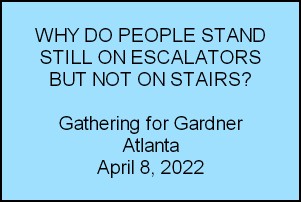
There are two kinds of people in this world: The first kind wonders why people stand still on escalators but not on stairs. The second kind wonders what’s wrong with the first kind. After all, if you stand still on the stairs you never get anywhere.

But people of the first kind are not usually dumb. I could give you a long list of top-rate economists and mathematicians who have been stumped by this puzzle. But I could also give you a long list of equally smart people who have been stumped by why anybody thinks it’s a puzzle in the first place. It’s come up again several times recently, because I included it in Can You Outsmart an Economist? and because I talked about it on my podcast with Bob Murphy, which generated a small flurry of email from listeners. So let me try once again to explain what’s going on here.

Let’s divide this into two parts: First, what’s the right way to think about this problem? Second, why is it a problem in the first place?

Continue reading ‘Ups and Downs’

Print Friendly, PDF & Email
Share

Trolling

trollsA commenter in another thread wanted to talk about trolls, so I’m opening up a new post where they’ll be on topic.

The specific trolls I have in mind operate toll-booths (or troll-booths?), both of which you must pass through to get from Hereville to Thereville. The question is whether you, as a traveler, prefer to have both booths controlled by a single troll, or by separate trolls. (This is Problem 12 in Chapter 3 of Can You Outsmart an Economist?.)

(SPOILER WARNING!)

Continue reading ‘Trolling’

Print Friendly, PDF & Email
Share

On Backward Induction

A Guest Post

by

William Carrington

(Note from the proprietor—I am delighted to present this guest post from my correspondent William Carrington, who might or might not have been inspired by the puzzles in Chapter Nine of Can You Outsmart an Economist?. — SL)

Like zombies and Russian spies, there are more economists among us than you might think. This can be dangerous because studies show that economists are more likely than normal people to graze their goats too long on the town commons, to rat out their co-conspirators in jailhouse interrogations, and to show up drunk on their last day at a job. This appears to be both because unethical people are drawn to economics and because economics itself teaches people to be both untrusting and untrustworthy. This feedback loop has led to the creation of famously difficult economists like John Stuart Mill and….well, it’s a long list. Like halitosis and comb-overs, the problem is worse in Washington.

Can you protect yourself against this unseen risk? Sadly, no, as economists often look all too normal and are hard to pick out from the maladjusted crowds that attend us. This is known as the identification problem in economics, and Norway’s Trygve Haavelmo was awarded a Nobel Prize for his work on this issue. Related work by Ken Arrow, also a Nobelist, proved that an infinitesimal group of economists will bollix up the welfare of an arbitrarily large population of otherwise normal people. It’s most disheartening, but I’m here to offer you a failsafe method for identifying economists. You’ll need an old refrigerator.

Continue reading ‘On Backward Induction’

Print Friendly, PDF & Email
Share

Quadratic Voting: A Pre-Primer

In honor of the forthcoming visit of Glen Weyl to the University of Rochester, I thought I’d offer a post explaining the idea behind one of Glen’s signature policy reforms: quadratic voting.

Suppose we’re going to hold a referendum on, say, whether to build a street light in our neighborhood.

The problem with giving everybody one vote is that (on both sides of the issue) some people care a lot more about that street light than others do. We’d like those who care more to get more votes.

In fact, we’d like to allocate votes proportional to each voter’s willingness to pay to influence the outcome. There are excellent reasons to think that willingness-to-pay is the right measure of “caring”. Those reasons will be evident to readers with some knowledge of welfare economics and opaque to others, but it would take us to far afield for me to get into them here. (For the record, if you’re encountering this measure for the first time, you’re almost surely raising “obvious” objections to which there are non-obvious but excellent rejoinders.) For this discussion, I’m going to take it as given that this is the right way to allocate votes.

Here’s the problem: If I allocate votes based on willingness to pay, people will simply lie. If you’re willing to pay up to $1 to prevent the street light, but know that you can get more votes by exaggerating your passion, that’s what you’ll probably do.

Okay, then. If we want to allocate votes based on willingness to pay, then we have to make people actually put some money on the table and buy their votes, thereby proving that they care. We could, for example, sell votes for $1 each. That way, people who care more will buy more votes and have more influence, as they should.

Unfortunately, that’s not good enough. If you care more about the issue than I do, you might buy more votes than I do — but there’s no reason to think you’ll buy more votes in direct proportion to your willingness to pay. Let’s suppose, for example, that the ability to cast a vote is worth $2 to you and $4 to me. Then I should get twice as many votes as you. But if votes sell for $3, I might buy quite a few, whereas you’ll buy none at all. That’s a lot more than twice as many.

So let’s try again: Instead of selling votes for a fixed dollar amount, we sell them on an increasing scale. You can buy one vote for a dollar, or two votes for four dollars, or three votes for nine dollars — and we’ll even let you buy in tiny fractions, like 1/10 of a vote for a penny. The price you pay is the square of the number of votes you buy. That’s the definition of quadratic voting.

Why the square, as opposed to the cube or the square root or the exponential? There really is something special about the square. To appreciate it, try an example: If a vote is worth, say, $8 to you, you’ll keep buying additional votes as long as you can get them for less than $8 each, and then stop. With quadratic voting, one vote costs you a dollar. You’ll take it! A second vote costs you an extra $3 (bringing the total to $4). You’ll take that too! A third vote costs you an extra $5, a fourth costs you an extra $7, and a fifth costs you an extra $9. So you’ll buy 4 votes and then stop. You can similarly check that if a vote is worth $24 to your cousin Jeter, Jeter will buy twelve votes and then stop. Jeter cares three times as much as you do, and he buys three times as many votes. And with a little calculus, you can check that if Aunt Murgatroyd’s vote is worth four or five or nine or twenty times more to her than your vote is to you, she’ll buy exactly four or five or nine or twenty times as many votes as you do. That’s exactly what we wanted. In that sense, this voting scheme works — and, except for minor variations, it’s the only scheme that works.

Continue reading ‘Quadratic Voting: A Pre-Primer’

Print Friendly, PDF & Email
Share

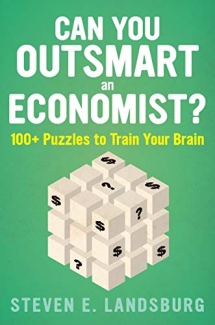
Can You Outsmart an Economist?

Can You Outsmart an Economist?

100+ Puzzles to Train Your Brain

My new book is now on sale! Readers of this blog will recognize some but not nearly all of these 100+ puzzles (146, actually, by my count). If you’ve enjoyed my puzzle posts, you’ll probably enjoy these extended discussions of some past puzzles, and the many more that are entirely new. Most of these puzzles are designed to teach important lessons about economics, broadly defined to encompass all purposeful human behavior. All of them are also designed to be fun.

Once you’ve had a look, please don’t hesitate to share your opinions right here on the blog — or better yet (especially if your opinions are positive!) don’t hesitate to share them on Amazon or on Goodreads.

Or, if you’d prefer to taste the milk before you buy the cow, here is the introduction, absolutely free of charge.

You can read a few advance reviews here. And remember, the more copies you buy, the sooner I’ll write the sequel.

Click here to comment or read others’ comments.

Print Friendly, PDF & Email
Share

Efficient Tariffs

You’re a policymaker in a country where people buy widgets that are produced both at home and abroad. You can set (separate) excise tax rates on domestic production and imports. (The tax on imports is, of course, what we usually call a tariff.) What tax rates should you set?

The Economics 101 answer makes two assumptions:

1. You care only about the economic welfare of your citizens (and not at all about foreigners).

2. You can’t affect foreign prices (i.e. your country is a negligible portion of the world market for widgets). The fancy way to say this is that the supply of imports is perfectly elastic.

From these assumptions, it follows that both tax rates should be zero. In fact, we can relax assumption 1) and allow you to care as much as you want about the welfare of foreigners; the conclusion doesn’t change.

But suppose we relax these assumptions in a different way:

1A. You care about both the economic welfare of your citizens and (separately) about the tax revenue earned by your government. (I continue to assume, however, that you don’t care about foreigners.)

2A. The foreign supply curve might not be perfectly elastic. Contrary to the Economics 101 assumption, this gives you some market power that you might want to exploit. (I continue to assume, though, that you take the foreign supply curve as given. In particular, this means that your policies do not affect foreign tax rates, so I am assuming away things like retaliatory tariffs.)

Now what’s your best policy? I can’t answer that because you have two competing goals (economic welfare and tax revenue) and I don’t know how much weight you put on one versus the other. But surely if I can show you that Policy A delivers on both goals better than Policy B, you’ll want to reject Policy B. The existence of Policy A leads me to call Policy B inefficient, and surely you’ll want to reject any inefficient policy.

So which pairs of tax rates are efficient?

Continue reading ‘Efficient Tariffs’

Print Friendly, PDF & Email
Share

Good Intentions; Bad Policy

I learn from Scott Sumner’s blog that in many California cities, residents with past marijuana convictions will jump to the head of the line for licenses to sell the drug legally — this by way of compensating them for past persecution.

Scott approves. I don’t, for two reasons:

First, if you want to compensate people for past persecution, the right way to do it is with cash, not by misallocating productive resources. If there must be licenses, they should be allocated to those who can use them most efficiently, regardless of any past history.

Second, drug dealers have never been the primary victims of anti-drug laws. They can’t be, because there is free entry and exit from that industry. Anti-drug enforcement leads to exit, which in turn leads to higher profits for those who remain — and the exit continues until the profits are high enough to compensate for the risks. One way to think about this: All those “persecuted” drug dealers were, in effect, employing the government to stifle their competition, and paying a fair price for that privilege in the form of occasionally being convicted and punished themselves.

The primary victims of anti-drug legislation are potential consumers who were deterred by artificially high prices. How do you compensate those victims? You can’t. In a population of 1000 people who have never used drugs, it’s quite impossible to identify the 200 or 300 or 400 who would have happily indulged if only the price had been lower.

Continue reading ‘Good Intentions; Bad Policy’

Print Friendly, PDF & Email
Share

Too Many People?

It was both an honor and a pleasure to deliver the annual Hayek Lecture at the Institute for Economic Affairs last week. Here’s the video:

Click here to comment or read others’ comments.

Print Friendly, PDF & Email
Share

WTF?! Indeed!

Like most bloggers, I assign each of my posts to one or more Categories, which are listed in small print somewhere near the top of the post. Among the categories I use are “Economics”, “Politics”, “Policy”, “Math”, “Logic”, “Cool Stuff”, “History”, “Oddities” and “WTF?”. The last of these is perfect for this post, which is written to call your attention to Peter Leeson‘s rollicking new book WTF?!: An Economic Tour of the Weird.

(Edited to add: I see now that the jacket copy on Leeson’s book describes it as “rollicking”. Apparently I’m not the only one who thought this was the right adjective here.)

Leeson, some of whose work I’ve blogged about here in the past, takes us on a tour of some of the world’s seemingly most inexplicable behavior — both historical and contemporary — and uses economic insight to render that behavior explicable after all. His explanations are generally plausible and provocative, though I’m sure many an insightful reader will find plenty to argue with. That, after all, is part of the fun.

Here are the blurbs from the back of the book:

Continue reading ‘WTF?! Indeed!’

Print Friendly, PDF & Email
Share

Weight Loss Advice From Big Name Economists

In my dream, Greg Mankiw and Larry Summers are advising a friend about weight loss.

Mankiw says: If you eat fewer calories, you’ll lose weight.

Summers replies: Not so fast! Sometimes if you eat less ice cream, you crave more cake. Then your calorie intake won’t change and you won’t lose weight. Greg’s advice is fine as an academic theory, but I doubt it will work in practice.

(Note here that Greg never mentioned ice cream in the first place.)

Of course Greg is 100% right, both in theory and in practice. If you eat fewer calories, you will lose weight. Summers responds that if you don’t eat fewer calories, you might not lose weight. True, but entirely off the mark.

I mention this because Mankiw had a recent blog post where he argued that if you cut taxes on capital income you’ll see a big rise in wages. (I happen to have blogged about this twice already in the past 24 hours, but those posts are irrelevant here.) Summers has replied that Mankiw is right in theory but likely to be wrong in practice, and lists three reasons. The first of those reasons comes down to saying that if you cut the corporate income tax, corporations are likely to end up paying more in other taxes, so you haven’t really cut the capital tax after all.

(Note here that Greg never mentioned corporate taxes in the first place.)

Okay, fine. So if you haven’t cut the capital tax, then Greg’s observation doesn’t apply. Likewise, if you haven’t really cut calories, you shouldn’t expect any weight loss. That’s not remotely a refutation.

Continue reading ‘Weight Loss Advice From Big Name Economists’

Print Friendly, PDF & Email
Share

Mankiw Followup

Earlier today, I blogged about Greg Mankiw’s calculation on the effects of capital tax cuts.

Following a tax cut, Mankiw computes the ratio of the long-run increase in wage payments to the short-run shortfall in government revenues, and, with reasonable assumptions, shows that this ratio has an astonishingly high value of 3/2.

I know how to make that ratio even higher.

The Mankiw Plan is: Cut capital taxes today and watch wages rise tomorrow. The Landsburg Plan is: Cut capital taxes tomorrow and watch wages rise the next day.

Under the Landsburg Plan, the short-run government revenue shortfall (today) is zero, while the long run increase in wages is positive. That gives me a ratio of infinity, which beats Mankiw’s 3/2 ratio by a factor of … infinity.

This is not meant to cast doubt on Mankiw’s result (which is entirely responsive and relevant to the current public debate he was addressing); it is meant to cast light on what’s driving it. When you cut taxes, government revenue falls by more in the long run than in the short run. The long run fall in revenue is what’s driving the wage growth (as I showed in my earlier post), and what drives the result is that the long run fall in revenue is greater than the short run fall. If you can drive down the short-run fall, you can drive up the ratio.

Click here to comment or read others’ comments.

Print Friendly, PDF & Email
Share

It’s All About the Rectangles

Greg Mankiw has a provocative post on how wages are affected by a cut in the tax rate on capital income. The short version: The effect is huge. If the government commits to a permanent tax cut that costs it $1 in revenue this year, then in the long run, annual wage payments will rise by $1.50 (and the annual revenue shortfall will be even less than $1).
.

That strikes me as huge. Wages grow by more than government revenue falls — in fact, by a factor of about 1/(1-t), where t is the initial tax rate. Mankiw’s $1.50 comes from plugging in an initial tax rate of 1/3.

Although Mankiw’s calculation is simple, straightforward and convincing, it managed to drive me crazy for a substantial chunk of a day, because I didn’t really understand what was driving it. Now I do. So let me explain.

Continue reading ‘It’s All About the Rectangles’

Print Friendly, PDF & Email
Share

Politico Economy

Matthew Nussbaum of Politico tweets that:

There are 50,000 coal miners in the United States. There are 520,000 fast food cooks. Coal miners seem to loom a lot larger in our politics. Wonder why.

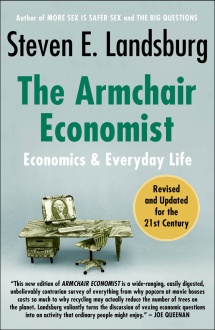
If Mr. Nussbaum had read pages 36 and 37 of The Armchair Economist, he’d know the answer. Coal mines are in pretty much fixed supply; new fast food joints are created all the time. Therefore new coal mining jobs are far harder to create than new fast food jobs.

So if conditions get better for coal miners, that’s good for existing coal miners. By contrast, if conditions get better for fast food cooks, more people will become fast food cooks, driving down the wages of existing fast food cooks and negating the improved conditions.

That makes it worthwhile for coal miners to lobby for better conditions, but not for fast food cooks. What’s relevant is not so much the current population of coal miners, but the ease with which that population can expand.

Continue reading ‘Politico Economy’

Print Friendly, PDF & Email
Share

Missed Opportunities

I haven’t seen any of the details, but it looks like the Republican health care plan suffers from many of the same defects as Obamacare, and is in some ways worse.

Mainly: As far as I am currently aware, the plan pretty much leaves in place the main ongoing problem with health care, which is that most people are grossly overinsured, so that health care choices are too frequently made by insurance companies instead of by (cost-aware) consumers and providers. The solution, in broad terms, is to replace insurance with individual health savings accounts (which, if you’re worried about this sort of thing, can be just as heavily subsidized as insurance is). Plenty of Republicans know this, and have been saying it for a long time. But — at least according to what’s in the early news reports — they seem to have come up with a bill that ignores it.

In fact, the Republican bill makes things worse in at least one way, by lifting the Cadillac tax on employer-provided health care plans, thereby encouraging even more overinsurance.

Presumably this was the compromise among feuding factions that the Republican caucus was able to hammer out. Presumably, too, a little leadership from the one person with veto power could have yielded a much better outcome. Too bad the one person with veto power is a self-obsessed loonybird. I do believe a President Bush or a President Cruz — or even, perhaps, a President Clinton — would have insisted on something far far better.

Click here to comment or read others’ comments.

Print Friendly, PDF & Email
Share