This is an extremely elementary post about numbers. (”Numbers” means the natural numbers 0,1,2 and so forth.) It is a sort of sequel to my three recent posts on basic arithmetic, which are here, here and here. But it can be read separately from those posts.
Today’s question is: Do numbers exist? The answer is: Of course, and I don’t believe there’s much in the way of serious doubt about this. You were familiar with numbers when you were five years old, and you’ve been discovering their properties ever since. Extreme skepticism on this point is almost unheard of among mathematicians or philosophers, though it seems to be fairly common among denizens of the Internet who have gotten it into their head that extreme skepticism makes them look sophisticated.
Let me be clear that I am not (yet) asking in what sense the natural numbers exist — whether they have existed since the beginning of time, or whether they exist outside of time, or whether they exist only in our minds. Those are questions that reasonable people disagree about (and that other reasonable people find more or less meaningless.) We can — and will — come back to those questions in future posts. For now, the only question: Do the natural numbers exist? And the answer is yes. Or better yet — if you believe the answer is no, then there’s obviously no point in thinking about them, so why are you reading this post?
Continue reading ‘Basic Arithmetic: On What There Is’
Print
During our brief intermission last week, commenters chose to revisit the question of whether arithmetic is invented or discovered—a topic we’d discussed here and here. This reminded me that I’ve been meaning to highlight an elementary error that comes up a lot in this kind of discussion.
It is frequently asserted that the facts of arithmetic are either “tautologous” or “true by definition” or “logical consequences of the axioms”. Those are three different assertions, and all of them are false. (This is not a controversial statement.)
The arguments made to support these assertions are not subtly flawed; they are overtly ludicrous. Almost always, they consist of “proof by example”, as in “1+1=2 is true by definition; therefore all the facts of arithmetic are true by definition”. Of course one expects to stumble across this sort of “reasoning” on the Internet, but it’s always jarring to see it coming from people who profess an interest in mathematical logic. (I will refrain from naming the worst offenders.)
So let’s consider a few facts of arithmetic:
Continue reading ‘Just the Facts’
Print
Yesterday we started a conversation about whether mathematics is invented or discovered. Today I’ll give you my three best arguments for “discovered”. And to focus the discussion, I’ll talk not about mathematics generally but about the natural numbers (0,1,2, and so forth) in particular.
I believe the natural numbers exist, quite independently of whether anyone’s around to think of them. Here’s why: First, we perceive them directly. Second, we know non-trivial facts about them. Third, they can explain the Universe. In more detail:
Continue reading ‘Real Numbers’
Print

Is mathematics invented or discovered? In my experience, applied scientists often think of mathematics as a human invention, while actual mathematicians (with a few notable exceptions) feel sure that mathematics was always there to be discovered. (Of course, it’s sometimes hard to tell how much of this is genuine disagreement and how much is a language barrier.)
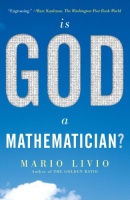
I’ve just finished reading an excellent book by Mario Livio which is entirely about the invention/discovery question, though he’s chosen the (somewhat unfortunate) title Is God a Mathematician? Much of the book is a lively romp through mathematical history, with a well chosen mix of biography and exposition. Although he parts company with them in the last chapter, Livio gives a more than fair hearing to the many great mathematicians who have insisted that they are discoverers, from Pythagoras through Galileo, G.H. Hardy, Kurt Godel, and the contemporary Fields Medalist Alain Connes (among others). Here, for example is Connes:
Continue reading ‘Jellyfish Math’
Print
The Intelligent Design folk tell you that complexity requires a designer.
The Richard Dawkins crowd tell you that complexity must evolve from simplicity.
I claim they’re both wrong, because the natural numbers, together with the operations of arithmetic, are fantastically complex, but were neither created nor evolved.
I’ve made this argument multiple times, in The Big Questions, on this blog, and elsewhere. Today, I aim to explain a little more deeply why I say that the natural numbers are fantastically complex.
Continue reading ‘Non-Simple Arithmetic’
Print
As I mentioned the other day, I’ve recently (at the direction of my old friend Deirdre McCloskey) been reading some of the work of John Polkinghorne, the physicist-turned-theologian who seems to write about a book a week attempting to reconcile his twin faiths in orthodox science and orthodox Christianity.
Although Belief in God in an Age of Science is a very short book, it is too long to review in a single blog post. Fortunately, though, much of the non-lunatic content is concentrated in roughly the first ten pages, so I’ll comment here only on those.
Polkinghorne begins in awe. He is awestruck by the extent to which our Universe seems to have been fine-tuned to support life; this is the subject matter of the much-discussed anthropic cosmological principle. To take just one example (which Polkinghorne does not mention): The very existence of elements other than hydrogen and helium depends on the fact that it’s possible, in the interior of a star, to smoosh three helum atoms together and make a carbon atom; everything else is built from there. But it’s not enough to make that carbon atom; you’ve also got to make it stick together long enough for a series of other complicated reactions to occur. Ordinarily, that doesn’t happen, but now and then it does. And the reason it happens even occasionally is that the carbon atom happens to have an energy level of exactly 7.82 million electron volts. In fact, this energy level was predicted (by Fred Hoyle and Edwin Salpeter) before it was observed, precisely on the basis that without this energy level, there could be no stable carbon, no higher elements, and no you or me.
Continue reading ‘Life, the Universes and Everything’
Print
Among the things you’re sure of, which are you surest of? For Richard Dawkins, writing in the Wall Street Journal, it’s the theory of evolution:
We know, as certainly as we know anything in science, that [evolution] is the process that has generated life on our own planet.
Now, I would be thunderstruck if the theory of evolution turned out to be fundamentally wrong, but not nearly so thunderstruck as if arithmetic turned out to be inconsistent. In fact, I can think of quite a few things I’m more sure about than evolution. For example:
1. The consistency of arithmetic. (This amounts to saying that a single arithmetic problem can’t have two different correct answers.)
2. The existence of conscious beings other than myself.
3. The fact that the North won the American Civil War. (That is, historians are not universally mistaken about this. I am not interested in quibbling about what constitutes a “win”; I mean to assert that the North won in the everyday sense of the word, as reported in all the history texts.)
Continue reading ‘What Are You Surest Of?’
Print
I said this in The Big Questions and I’ll say it again: Richard Dawkins is an international treasure and one of my personal heroes, but he’s got this God thing all wrong. Here’s some of his latest, from the Wall Street Journal:
Where does [Darwinian evolution] leave God? The kindest thing to say is that it leaves him with nothing to do, and no achievements that might attract our praise, our worship or our fear. Evolution is God’s redundancy notice, his pink slip. But we have to go further. A complex creative intelligence with nothing to do is not just redundant. A divine designer is all but ruled out by the consideration that he must be at least as complex as the entities he was wheeled out to explain. God is not dead. He was never alive in the first place.
But Darwinian evolution can’t replace God, because Darwinian evolution (at best) explains life, and explaining life was never the hard part. The Big Question is not: Why is there life? The Big Question is: Why is there anything? Explaining life does not count as explaining the Universe.
Continue reading ‘There He Goes Again’
Print