If I could choose any name I wanted and require everyone to call me by that name, I think I would probably go with something considerably more creative than “Francis”. Just saying.


If I could choose any name I wanted and require everyone to call me by that name, I think I would probably go with something considerably more creative than “Francis”. Just saying.
 I am not one of the public intellectuals who were queried by The Atlantic (link might require subscription) as to which date most changed world history — but on the Internet, you can always spout off without an invitation.
It’s hard to argue with Freeman Dyson, who nominates the day an asteroid wiped out the dinosaurs, clearing the evolutionary path for the likes of you and me.
(Actually, it’s remarkably easy to argue with Freeman Dyson. I know this, having done so over tea in Princeton, many years ago. He made it very easy indeed, despite (or perhaps because of) the fact that he was 100% right and I was 100% wrong.)
At the opposite end of the intellectual spectrum, the standup comedian W. Kamau Bell, after lamenting that there’s no way he can get this right so he might as well punt, nominates the day Michael Jackson first performed the moonwalk on national TV. Unfortunately, his intent to give the most ridiculous possible answer is thwarted by one Neera Tanden of something called the Center for American Progress, who, with an apparently straight face, nominates August 26, 1920 (the day American women gained the right to vote) — an answer that begins by placing 20th century America at the center of the Universe and proceeds downhill from there.
Other 20th-century answers (the assassination of Archduke Ferdinand, Hitler’s invasion of the Soviet Union) are at least more serious, and I think that Anne-Marie Slaughter‘s nomination of the still-very-recent-by-historical-standards signing of the Declaration of Independence on July 4, 1776 is even defensible. But then what about the Glorious Revolution of 1688, which arguably laid the political and intellectual groundwork that made the Declaration possible?
Continue reading ‘The Most Important Date Ever’
Is the public debt a drag on economic growth? Economist Salim Furth reviews the evidence here and finds cause for alarm.
My own instincts are substantially less alarmist, but it should be noted that unlike me, Furth (and those he quotes) have spent substantial time thinking hard about this question.
Christy Romer, writing in the New York Times, deems the Earned Income Tax Credit a more palatable alternative to the minimum wage. So do I. (So, I feel confident, do the great majority of economists). But there is almost no overlap between Romer’s reasons and mine. I believe her reasons are wrong.
First, Romer observes (correctly) that while the minimum wage tends to reduce employment (though perhaps not by very much), the EITC has the opposite effect. That’s because the minimum wage is essentially a tax on hiring unskilled labor, while the EITC is a subsidy. When you tax something you get less of it; when you subsidize something, you get more.
But, contra Romer, that’s no reason to prefer the EITC. Since when, after all, is it automatically better to have too much of something than too little? Underemployment and overemployment are both bad things. Indeed, if the minimum wage (for whatever reason) has very little effect on employment while the EITC increases it substantially past the efficient level, that’s a good reason to prefer the minimum wage.
Continue reading ‘Romer on Minimum Wages’
The Future of Freedom Foundation plans to livestream my talk this afternoon, titled “More Sex is Safer Sex and Other Surprises”. I believe you’ll be able to find the stream here. Starting time (I think!) is 6PM.
Update: livestream cancelled for techical reasons but high quality video will be available in a few days.
Friday March 1 Tuesday, March 5 (note date change!): Our occasional commenter Sierra Black will discuss polyamory on the Katie Couric show; 3PM eastern time in many cities, but check local listings.
Monday, March 4, 5:30PM: I’ll be speaking in the Economic Liberty Lecture Series, sponsored by the Future of Freedom Foundation, at George Mason University in Fairfax, VA. I’m a little unclear on the exact location; this link and this link seem to contradict each other — but they do both give phone numbers to call for further information. Admission is free.
Imagine you’ve got a drinking problem. And imagine this conversation with your spouse:
Spouse: Dear, you’ve really got to do something about your drinking. You’ve been in three auto accidents this week, you’ve lost your job, and you’ve been trying to beat the children, though you keep passing out before you can get to them. I want to help you figure out how to get this under control.
You: You’ve got a fair point there. But let me point out that it would also be a good idea to redecorate the living room.
Spouse: Well, maybe so, and it’s something we can talk about at some point. But right now, I’d really like to focus on the drinking issue.
You: Doesn’t that strike you as imbalanced? Here we’ve got two issues on the table, and you want to focus 100% on one of them and 0% on the other. Why are you being so one-sided?
Spouse: Well, but I feel like there’s some urgency about the drinking thing, and I’d like to prioritize it.
You: Apparently, you’re fanatical on this issue. I don’t see how I can continue to take you seriously.
Spouse: Well, actually I’m trying to get you to focus on a very serious issue.
You: Yes, but by focusing exclusively on that issue, you’re betraying your fanaticism. Clearly, I’m the one who’s willing to address our problems, and you’re the one who’s just out to score debating points.
Spouse: Huh?
You: Not only that, but I’ve got a Nobel-prize winning economist who agrees with me!
How does that make you feel? I feel that way a lot when I read the news lately. Arguably, our country faces a spending crisis. The Republicans claim they want to deal with that crisis. (There’s some legitimate question about how sincere they are, but they at least say they want to deal with it.) The Democrats say: Okay, but let’s also talk about raising taxes. Maybe they’d also like to talk about redecorating the Rotunda; this seems roughly as pertinent. In other words, the Democrats attempt to deflect attention from the crisis (or the alleged crisis) by insisting that we talk about some other thing at the same time — and then they insist that the Republicans, by insisting that we focus on the issue at hand, are “betraying their fanaticism”. And they’ve managed to find a Nobel-prize winning economist willing to parrot this nonsense almost daily on the pages and webpages of the New York Times.
Continue reading ‘Deficit Attention Disorder’
Paul Krugman is at it again, bemoaning the mendacity of politicians who, for “careerist reasons”, will never admit their mistakes and therefore lock themselves into bad policies. He even quotes Ralph Waldo Emerson:
A foolish consistency is the hobgoblin of little minds,
adored by little statesmen and philosophers and divines.
And Krugman’s solution to this problem? More power for the politicians, of course.
This blows me away:
Suppose you pay children in the 5th and 6th grades, right when you think of the achievement gap opening up between blacks and whites, to take an IQ test.
Say you have unmotivated black kids living in the middle of the ghetto and white kids from Scarsdale or some other upper-class neighborhood. You give each kid who gets a successful answer one M&M — just give them an M&M — and you say for each point extra on the IQ test, each correct answer, I’ll give you one more M&M. It turns out that the gap between the black and white student in the IQ test scores vanishes — vanishes completely.
If I’d heard this from almost anyone else, I’d be instantly skeptical. But I heard it from Jim Heckman, who sets the standard for caution and reliability in social science. I highly recommend the whole interview; you can read it here.
 |
 |
The Big Questions is likely to be down intermittently between about 9PM and 11PM eastern time on Friday, 2/22 for scheduled maintenance.
The usual case against the minimum wage has three components:
The problems with this case are that
Minimum wages are bad policy, though — but for entirely different reasons.
I’ll get to those reasons shortly, but first let’s examine the traditional argument a little more closely. I’ll number my paragraphs to make it easier for commenters to respond.
Continue reading ‘Thoughts on the Minimum Wage’
The new issue RegionFocus (the magazine of the Richmond Federal Reserve) is out, including an interview with yours truly.
There are a few things I might wish I’d said a little differently, but Aaron Steelman (the interviewer) did a fantastic editing job.
Continue reading ‘It’s All About Me’
Paul Krugman, apparently relying on the stupidity of his readers, opens with this quote:
“At some point, Washington has to deal with its spending problem,” Speaker John A. Boehner of Ohio said Wednesday. “I’ve watched them kick this can down the road for 22 years since I’ve been here. I’ve had enough of it. It’s time to act.”
Then Krugman comments as follows:
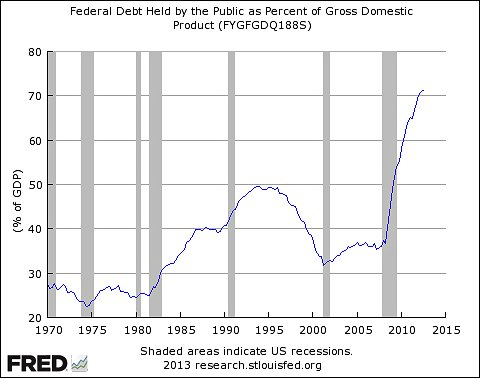
22 years, huh? Indeed, Boehner was elected in 1990, and entered the House at the beginning of 1991. So what kind of can-kicking was going on during his first, say, decade in office? Here’s the picture:
Hmm — it sort of looks as if the US was sharply reducing its debt during the presidency of a guy named, I don’t know, Bill something or other.
See what he did there? Boehner says something about spending; Krugman responds with an irrelevant chart depicting debt, and hopes you won’t notice he’s completely changed the subject.
Continue reading ‘Paul Krugman Hopes You’re Stupid’
On allexperts.com, we find the following query:
How can I find a list of retail markup % by industry? My husband won’t let me buy new lamps because his mother worked in a lamp store 60 years ago and the markup was “astronomical”. I’m betting that there are plenty of things he buys that have a similar markup as do lamps. I know that the average markup varies between industries (i.e. groceries being very low). Appreciate any insight! Thanks!!!!
Several questions arise, or which the most compelling is: When you buy a lamp, why would you care about the markup, as opposed to, oh, say, the price? In fact, if you’re the sort of person who worries about things like minimizing your carbon footprint and otherwise curbing your resource consumption, you should of course prefer items with high markups, since the markup is the part of the price that doesn’t reflect resource consumption. Or to put this another way: Given the price of the lamp, isn’t it better for the seller to earn more profit rather than less?
Since economic theory tells me that the author of this inquiry is perfectly rational, I see only a small number of possibilities:
Continue reading ‘Can My Readers Throw Some Light On This?’
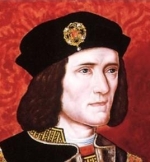 With Richard III much in the news lately, I’ve been inspired to reread Paul Murray Kendall’s excellent biography of the king (Kindle edition here). Here’s a little tidbit I learned from that book:
In early 1464, with Lancastrian rebellions breaking out all over England, King Edward IV found it prudent to raise an army. He therefore dispatched “commisions of array” to the twenty-two counties of southern England, each charged with rounding up the able-bodied men of the county and turning them into an army. In most cases, the county commission consisted of a half dozen or more men, including one great magnate. But Richard, Edward’s brother, inspired so much trust that he was appointed sole commissioner for nine counties — everything from Shropshire and Warwickshire through Somerset to Devon and Cornwall. Richard, in other words, was solely responsible for levying troops from a quarter of the realm. He was not yet twelve years old.
This makes me believe that my seventeen-year-old stepdaughter has too few chores.
 A man applies for a job, which requires him to undergo three days of testing. But just before the testing period begins, he gets another good job offer. How does this affect his effort and performance?
If you’ve got your economics-blinders on, you’ll probably answer: Once he’s got an offer in hand, he won’t try as hard and therefore won’t do as well. But Michigan grad student Susan Godlonton decided to put that theory to the test. She was here in Rochester this week to tell us what she learned.
Godlonton did her research in Malawi, where her research funds went a long way. 278 job applicants were recruited for a three-day training program, with job offers contingent on their performance. At the beginning of the training period, about 20% of the applicants (randomly chosen) were offered an alternative job; another 20% were randomly told they’d not be getting the alternative offer. (Still others were told they had various probabilities of receiving the alternative offer, but let’s concentrate on the extremes.) These alternative offers were kept secret from the evaluators at the training session.
The result: After controlling for background characteristics such as performance on standardized tests, previous experience, age, and so forth, applicants with no outside offer perform considerably worse in the training sessions, as measured by written exams, and the quantity and quality of their verbal participation. Those with alternative offers are 11.3% more likely to make verrbal contributions, and their verbal contributions are better.
Continue reading ‘Stress Test’
Valentine’s Day (i.e. February 14) will find me at the University of Maryland’s Baltimore County campus, speaking about why More Sex is Safer Sex. The lecture is free and open to the public. Join us if you’re in the neighborhood! More details here.
A friend asked this question in another forum. Maybe you guys can help:
Many of these towns have a road whose name comes from the next town over.
In the future, there will be companies whose workforces consist entirely of robots.
I’d prefer a book whose characters weren’t so stupid.
Are these correct uses of the word whose? On the one hand, we usually reserve the word “who” for people and use “that” for inanimate objects. On the other hand, the word “that” does not have a possessive form analogous to “whose”.
Every one of these sentences can of course be rewritten to avoid the problem (“I’d prefer a book with characters who weren’t so stupid”.) But the question is whether they sound okay to you as written.
A number of commenters (at least one here and several elsewhere) have asked why we need a debt ceiling. If the Congress wants to spend less, why don’t they just go ahead and spend less?
The answer is that different spending programs command different majorities. Snip and Snap vote to fund rabbit hospitals; Snap and Snurr vote to fund trapeze subsidies; Snurr and Snip vote to fund lava lamp research. Plausibly, they’d all prefer to eliminate all these programs. Even if Snap thinks rabbit hospitals and trapeze subsidies are both great bargains, he might not be so happy about getting two for the price of three.
Continue reading ‘Why The Debt Ceiling Matters’

Thus the headline in today’s New York Times. Well, the Tea Party was nice while it lasted.
The frequently brilliant David Henderson seems to me to have fallen off a cliff in his (limited) defense of the recent tax bill. David thinks it’s a (relatively) good thing that under the new bill, income taxes rise only for those making over $400,000 and the estate tax is locked in only for estates over $5 million. (Relative, that is, to an across-the-board increase.)
David, in other words, seems to be saying that it’s a good thing that the tax code just got more progressive, and that a very small number of people are now going to bear a significantly greater share of the burden. I disagree.
Taxes are too high because spending is too high. But taking the path of spending as given (and David is right when he says that the delay of the sequester bodes very ill for that path), the question is not “how high should taxes be?”; that question is settled. Over time, taxes will be high enough to cover the spending. The only question is “how should the tax burden be distributed?”. The answer the politicians have agreed on is “a whole lot less equally”. They’re taking less now than they might have, but they’ll have to take more in the future, and when that time comes, they’ll have set a precedent that the rich should bear a greater fraction of the burden than they did a month ago.
Continue reading ‘I Don’t Get It’
The fiscal cliff deal that passed the Senate last night is appalling.
It raises marginal tax rates at the top (allegedly to “Clinton era levels” but actually higher once you account for the phaseouts of personal exemptions and itemized deductions), but not for anyone else, nibbling away at the rewards for productivity, and placing an ever-greater share of the tax burden on an ever-smaller fraction of the population.
Edited to add: Greg Mankiw has pointed out to me that the phaseouts were present in the Clinton years as well, so my remark about today’s rates being “higher once you account for the phaseouts” is wrong. On the other hand, as Greg also points out, with the increase in Medicare taxes pursuant to Obamacare, total tax rates are in fact higher than they were under Clinton. Greg points to this link for clarification. |
Worse yet, it increases the rates on dividends, capital gains and inheritances, encouraging wealthy people to save less, consume more, and demand a greater share of the world’s resources.
The AMT, one of the few bright spots in the tax code, is permanently “fixed”, which is to say that almost nobody will pay it now.
This deal does absolutely nothing to control entitlement spending, which means it’s 100% fiscally irresponsible. Let’s be clear about this. When you’re overspending, the fiscally responsible thing is to spend less, not to cover the difference by visiting the ATM and depleting your assets. Wealthy taxpayers are the government’s ATM; the assets the government takes today won’t be there when they need more tomorrow. Let’s say it one more time: After all the talk about “fiscal responsibility”, there is nothing fiscally responsible about this deal.
Continue reading ‘Why Do I Feel Like I Fell Off a Cliff?’
Re the fiscal cliff, I’ve tried hard to keep my head in the sand, figuring I can always go back to watching the news in 2016. So I’m not completely up to date on all this stuff, and I might be missing something important. But here are a few last-minute observations:
Continue reading ‘Over the Cliff’
I think I’ll make the reposting of this an annual tradition:
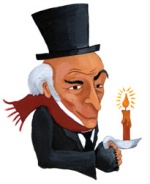 Here’s what I like about Ebenezer Scrooge: His meager lodgings were dark because darkness is cheap, and barely heated because coal is not free. His dinner was gruel, which he prepared himself. Scrooge paid no man to wait on him.
Scrooge has been called ungenerous. I say that’s a bum rap. What could be more generous than keeping your lamps unlit and your plate unfilled, leaving more fuel for others to burn and more food for others to eat? Who is a more benevolent neighbor than the man who employs no servants, freeing them to wait on someone else?
Oh, it might be slightly more complicated than that. Maybe when Scrooge demands less coal for his fire, less coal ends up being mined. But that’s fine, too. Instead of digging coal for Scrooge, some would-be miner is now free to perform some other service for himself or someone else.
Dickens tells us that the Lord Mayor, in the stronghold of the mighty Mansion House, gave orders to his 50 cooks and butlers to keep Christmas as a Lord Mayor’s household should—presumably for a houseful of guests who lavishly praised his generosity. The bricks, mortar, and labor that built the Mansion House might otherwise have built housing for hundreds; Scrooge, by living in three sparse rooms, deprived no man of a home. By employing no cooks or butlers, he ensured that cooks and butlers were available to some other household where guests reveled in ignorance of their debt to Ebenezer Scrooge.
Continue reading ‘Merry Christmas’
 Robert Bork will be remembered for many things, but the most important, and the reason we are so fortunate to have had him with us, is his eloquent and influential insistence that antitrust law is there to protect consumers, not to protect inefficient firms. The Supreme Court eventually agreed. He was, in my opinion, wrong about a lot of things, but he left the world better than he found it.
Assuming carbon emissions damage the environment, should they be discouraged through taxation? And if so, should the tax revenue be earmarked for damage abatement, or should it be paid into general funds?
Elizabeth Kolbert, writing in the New Yorker, suggests that economic theory decides this question in favor of a carbon tax. As I pointed out last week, she’s plain wrong. As a followup to some of the discussion on that post, here’s a simple example to illustrate that no policy can be infallible:
A steel mill pollutes the air, causing $24 worth of damage to the business of a laundromat next door. (Or if you prefer, read $24 worth of expected damage to the owners of oceanfront property or farmers in currently temperate zones.)
If the steel mill is forced to bear the consequences of this damage, it reduces its output. This cuts the pollution damage by $12, and cuts the profits of the steel mill by $17.
Question: Which is the best policy?
Answer: It depends. Consider the following scenarios:
Continue reading ‘Carbon Tax Policy: No Simple Answers’
Writing in The New Yorker, Elizabeth Kolbert illustrates the power of analogy:
A man walks into a bar. He orders several rounds, downs them, and staggers out. The man has got plastered, the bar owner has got the man’s money, and the public will get stuck with the tab for the cops who have to fish the man out of the gutter.
…..
The man pulls into a gas pump. He sticks his BP or Sunoco card into the slot, fills up and drives off. He’s got a full tank; the gas station and the oil company share in the profits. Meanwhile, the carbon that spills out of his tailpipe lingers in the atmosphere, trapping heat and contributing to higher sea levels. As the oceans rise, coastal roads erode, beachfront homes wash away, and, finally, major cities flood. Once again, it’s the public at large that gets left with the bill.
In both cases, Kolbert endorses the “fair and logical” solution: The man should be taxed to incorporate the costs that his choices impose on the rest of society.
I like this game. Can I play too?
A man chooses to build his house on the oceanfront instead of 100 miles inland. This makes him especially vulnerable to rising sea levels and therefore leads him to lobby for a carbon tax. The man gets his house; the builders and contractors share in the profits, and the public at large bears the consequence of higher gas prices.
Or even:
Some people want to burn a lot of carbon, which raises global temperatures, imposing costs on owners of oceanfront property. Other people want to protect their oceanfront property, imposing costs on the people who want to burn a lot of carbon. A journalist at the New Yorker convinces her readers that the only “fair and logical” solution to this conflict of interests is to come down entirely on the side of the property owners, leading to the implementation of suboptimal policies. The journalist gets paid, the magazine editors congratulate themselves on the influence of their writers, and the general public suffers the consequences.
Should the property owner and the journalist be taxed for exerting their malign influences?
Continue reading ‘A Little Knowledge Is A Dangerous Thing’
First Brad Delong claimed that we can’t know things by pure reason. In response, I offered a counterexample:
The ratio of the circumference of a (euclidean) circle to its radius is greater than 6.28 but less than 6.29
Now Delong attempts to “refute” this counterexample by observing that it doesnt tell us anything about neutron stars (!!!). Leave aside the fact that it actually does tell us quite a bit about neutron stars (the circumference-to-radius ratio for a neutron star is not equal to 2π, but you’d still be hard pressed to compute its value if you didn’t know what π was). The larger point is that knowledge doesn’t have to be about neutron stars to be knowledge. It can be knowledge about, oh, say, euclidean circles.
Of course, as DeLong rightly observes, “we reason like jumped-up monkeys using error-prone Humean heuristics on brains evolved to improve our reproductive fitness”. And of course it is equally true that we perceive like jumped-up monkeys using error-prone sensory apparatus evolved to improve our reproductive fitness. Yet DeLong appears to acknowledge that our perceptions are sometimes informative. (I use the word “appears” because, true to form, DeLong prefers hissing and stamping his feet to actually spelling out an argument.) Why, then, should reason be more suspect than perception? DeLong isn’t in the mood to tell us.
Continue reading ‘DeLong Shot’
So there’s this man-eating creature named Jozin who lives in a bog, and is vulnerable only to crop-dusting powder. The mayor promises his daughter in marriage to whoever can defeat the creature. A stranger comes to town, borrows a crop-duster, captures Jozin, and wins the daughter. The end.
This, I think, is as good an example as any of why a gripping story requires more than just a good beginning and a happy ending. But sometimes, a hefty dose of looniness can fully compensate for the complete absence of dramatic tension. Et voila: