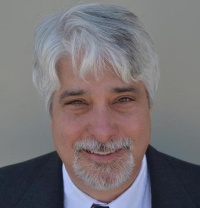
I mentioned earlier this week that I’d been crafting a long post on the fabric of the Universe when I was sidetracked by relatively mundane political events. Now I’ve been sidetracked again by the entirely unexpected (to me) news of the death from melanoma, at age 65, of the Fields Medalist Bill Thurston, who devoted his life to understanding the shape of space.
One-dimensional topology is the study of curves and two-dimensional topology is the study of surfaces. Both subjects are quite well understood. Thurston was the king of three-dimensional topology, which gains additional interest from the fact that we perceive ourselves as living in a three-dimensional Universe. Three-dimensional topology attempts to classify all the possible shapes for that Universe.
One of course is also interested in four, five, six and many-dimensional topology, four dimensions being of particular interest because they can be used to model space together with time. But although three dimensions are more complicated than two and two are more complicated than one, it turns out that when you go much higher, a lot of things get simpler. Consider knots, for example. There are no knots inside a one or two dimensional space; a knot needs three dimensions in which to pass over and under itself. But in more than three dimensions, you can untie any knot just by pulling on its ends — roughly because the additional dimensions give it so much space in which to untangle itself. For those and related reasons, topology is often hardest in three and four dimensions — coincidentally (or maybe not) the very dimensions most relevant to the way we experience the world.
Thurston revolutionized three-dimensional topology in the 1980s with his geometrization conjecture, which says that any three-manifold (the three-dimensional analogue of a smooth curve or surface) can be cut up into pieces, each of which exhibits one of eight permissible geometries. The simplest of those geometries is the flat three-dimensional space you think you see around you, where you can draw three straight lines in mutually perpendicular directions and extend them forever. Another is the geometry of the three-dimensional sphere, which is an analogue of the two-dimensional surface of the earth, where any “straight” line eventually circles back to meet itself.
The geometrization conjecture was important, but what really mattered was the vast array of new techniques Thurston introduced for visualizing and understanding the structure of three-manifolds. When those techniques came on line in the early 1980s, he was widely acclaimed as the mathematician of the decade.
One thing that set Thurston apart was his insistence that mathematics is a human study, and that it’s the mathematician’s job to communicate not just theorems and proofs, but a unique way of thinking. Stories are often told of mid-twentieth century mathematicians (usually French) who, when asked a question about their work, would scribble a picture on the blackboard, deliberately stand in front of that picture to shield it from everyone else’s view, and then, having studied it a few minutes, erased the picture, turned around, and gave a purely formal explanation designed to obscure all of the motivation and insight. Nobody ever told a story like that about Bill Thurston. Here he is, talking about the mystery of three-manifolds; dip in at a random moment and chances are excellent you’ll hear him talking not about how he proved a theorem but about how he sees the world:
Continue reading ‘The Visionary’