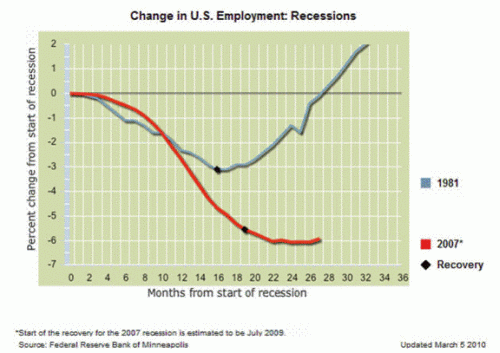
Did the stimulus create jobs?
Daniel Wilson of the San Francisco Federal Reserve Bank has just released what might be the first real evidence-based effort to resolve this question. One apparent problem with drawing inferences from the experience of the past couple years is that we have only one experiment to look at. But Wilson points out that in some sense, we have 50 separate experiments because stimulus spending differed substantially across states. You can potentially learn a lot from 50 experiments.
Unfortunately, they’re not controlled experiments, because stimulus funds were not allocated randomly. States with particularly weak economies probably got more Medicaid funds. States with bloated and inefficient bureaucracies might have been slow to complete necessary paperwork and hence slow to receive funds. If those weak economies or shamblng bureaucrats also had an effect on job growth, then the experiments are not clean.
But fortunately there are substantial components of the funds that were distributed according to objective formulas (demographics, number of highway miles, and so forth). Wilson makes competent use of these components, together with standard econometric techniques, to zero in on the subset of stimulus spending that can be considered effectively random. Now that he’s got his fifty more-or-less controlled experiments, he also controls for other confounding variables that could plausibly affect state-by-state economic growth. All of which is the right way to do this.
Continue reading ‘Did the Stimulus Work?’


















 The other big news story of the week was Tiger Woods’s apology, which merited a full two pages in the weekend edition of the Wall Street Journal. I was going to blog my thoughts on this, but my friend Nathan Mehl has said exactly what I wanted to say, and said it so much more brilliantly than I could possibly have said it myself, that I’m going to send you