There is allegedly a tradition of issuing a blank cartridge to one (randomly chosen) member of each firing squad, so that no shooter knows for certain that he contributed to a death. Let’s assume that tradition really exists and let’s assume that it exists because the shooters want it. Does that prove that shooters (at least in some instances) value ignorance?
Not necessarily. It might just mean that each shooter prefers a 5/6 chance of firing a real bullet over a 100% chance of firing a real bullet. That’s not the same thing as preferring to be ignorant.
So here’s the key experiment. Offer the shooters a choice:
Here’s where you’d ordinarily see our weekly roundup post. Unfortunately, I haven’t been able to get a web connection to my provider for the past several hours (though they’re definitely up and running); all attempts seem to stall while trying to pass through a downed machine in Chicago. Isn’t the whole point of the Internet supposed to be that there are multiple paths from everywhere to everywhere so this kind of thing can’t happen?
Be that as it may, I am logged into a shell account and posting this via lynx (if you don’t know what that means, you’re probably not as old as me), and the interface is far too painful to type anything substantive. So I’ll plan to post the usual roundup sometime tomorrow, after they’ve cleared the gunk out of the Intertubes.
The rationality quiz that I posted on Tuesday has drawn a lot of comments from folks who think they can reconcile inconsistent answers by appealing to risk aversion. That’s surely incorrect. To see why, let’s start with another quiz.
Question 0: Which do you like better, dogs or cats?
Economists would not presume to declare either choice an irrational one. There’s no accounting for tastes.
Paul Krugman says there’s been no surge in government spending. I say there has been. Paul offers a graph in evidence. I look at that same graph and see a four-year surge.
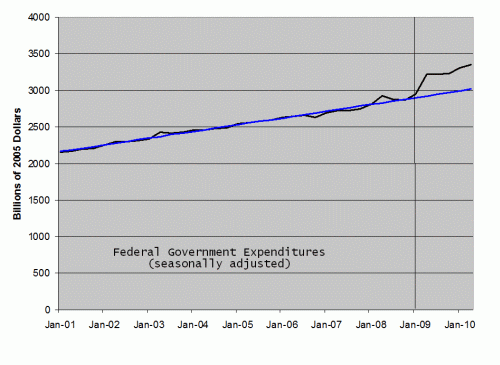
Several commenters have insisted that I am ignoring Paul’s point — the point being that if we take the Bush years as a baseline, then there’s been no surge relative to that baseline. Really? Here’s federal government expenditure from the beginning of the Bush years to today. The blue line projects a continuation of the average annual spending increases under Bush. The vertical bar marks the advent of the Obama age.
(I constructed this graph from the invaluable FRED database at the St. Louis Fed.)
Now personally, I look at this graph and the main thing I see is a ten-year surge in federal government expenditures. But if you insist on taking the Bush years as a baseline — well, then what you see, starting in 2009, is an Obama surge. You might or might not want to argue that the surge was justified (or compelled) by economic conditions, but I don’t see how you can deny it’s there.
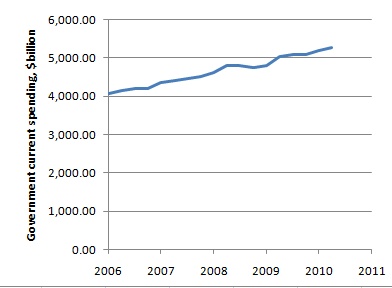
Paul Krugman offers the following graph as evidence that “spending hasn’t surged”:
Now, what I’m seeing here is something like a 25% increase in spending under the Bush/Obama policies of the past four years. Which makes me wonder exactly what it would take to count as a surge in Krugman-land.
********
On separate notes:
1) Yesterday’s post on rationality generated several comments that deserve responses. For the most part, I am reserving those responses for a separate blog post a few days down the line.
2) I just now hit a wrong button and deleted about 100 comments that my software had classified as spam, without first skimming through them. There is therefore a small but non-zero chance that I deleted a legitimate comment or two. If so, I very much apologize and hope you’ll try again.
The death this week of Nobel laureate (and relativity denier!) Maurice Allais reminds me that I’ve been meaning to blog about Allais’s famous challenge to the way economists think about rational decision making.
I’m going to ask you two questions about your preferences. In neither case is there a right or a wrong answer. A perfectly rational person could answer either question either way. But I do want you to think about your answers, and to write them down before you read any further.
Question 1: Which would you rather have:
A million dollars for certain
A lottery ticket that gives you an 89% chance to win a million dollars, a 10% chance to win five million dollars, and a 1% chance to win nothing.
Try taking this seriously. What would you actually do if you faced this choice? Don’t bother trying to figure out the “right” answer, because there is no right answer. Some perfectly rational people choose A, and other perfectly rational people choose B.
Okay, ready for the next question?
Question 2: Which would you rather have:
A lottery ticket that gives you an 11% chance at a million dollars (and an 89% chance of nothing)
A lottery ticket that gives you a 10% chance at five million dollars (and a 90% chance of nothing)
Once again, this is a matter of preference. There is no right or wrong answer. But decide what your answer is and write it down before you continue.
The Internet seems to have bred a peculiar subspecies of troll that cheerfully devotes enormous effort to refuting arguments nobody ever made. While they seem to have infinite time to construct these pointless rebuttals, these troll-types seem to have no time at all in which to actually digest the arguments they think they’re rebutting. They start with a guess as to what someone else might have said, and seem all but incapable of entertaining the notion that they might have guessed wrong. Is there a name for these people? “Crank” and “troll” are too general. If it were up to me, we’d reserve the word “Bozo” for this purpose, but it too is already in more general use. We need a new word! Give me your suggestions!
A title like More Sex is Safer Sex is like red meat to these folks and on Monday we took a moment to defend that argument against the latest Bozo Barrage (I’ll stick with this name till you give me a better one). Then on Tuesday we confronted a different subspecies of troll — the statistical obfuscator. Our reader Windypundit did some detective work and discovered that the offending graph was produced by an agency of the United States government. That, of course, is no excuse for perpetrating the deception.
Our graphical escapade led to a discussion of the gender gap in wages and whether it can be plausibly explained by employer discrimination. It’s often argued that it can’t, because that would require employers to sacrifice a profit opportunity. On Wednesday, I rejected that argument on the grounds that employers sacrifice profit opportunities all the time — but offered a (slightly) more sophisticated version that rejects the employer-discrimination hypothesis because it would require employers to sacrifice a very large profit opportunity. Of course, as our reader Patrick observes, this still doesn’t rule out the hypotheses of customer-discrimination or employee-discrimination. (In the latter case, male workers refuse to accept female colleagues. And again, the argument I gave can’t reject this. On the other hand, a different argument probably can — if the wage gap were driven by employee-discrimination, firms could profit not by hiring a few more females, but by hiring only females. In equilibrium, you’d expect half of all firms to be all female, half all male, and wages to be equalized across firms.
Thursday I reran a year-old post on how to add all the positive integers and get -1/12. This post generated just one comment! I’m not sure whether this was because none of you like this kind of thing, or whether you found it too awesome to remark on.
If you like this blog, then you either are or should be a fan of the late Martin Gardner, the long-time “Mathematical Games” columnist for Scientific American. On the 21st of October (what would have been Gardner’s 96th birthday), “Gatherings for Gardner” will take place around the world, where fans can share their favorite puzzles, ideas, magic tricks and reminiscences in what’s being billed as a global “celebration of mind”. You’re welcome to attend one of these events — or to host one.
(Potential attendees would surely benefit from a list of locations in lieu of having to navigate that idiotic map, but that’s what’s there.)
It was at a previous Gathering for Gardner that puzzle designer Gary Foshee posed his notoriously tricky probability puzzle about the mom with a son born on a Tuesday. (Spoilers here.) If you host or attend a gathering, do come back here and share your favorite finds.
About a year ago, when I was a novice blogger, I posted a piece called “A Little Arithmetic”. The arithmetic all looked fine in my browser, but I failed to realize that it might not look fine in everyone’s. As a result, some of you found it unreadable. But I like to think it was worth reading, so now that I’ve figured out how to make it look nice, I’m posting it again:
The mathematician John Baez has been dazzling science lovers on the web for over 15 years with his weekly Finds in Mathematical Physics. (He was a blogger long before there were blogs). Baez recently gave a lovely series of talks on his favorite numbers (they are 5, 8 and 24) in which he mentions Euler’s observation that if you sum up all the positive integers (1 + 2 + 3 + 4 + …) you get -1/12. (I promise, this is not a joke.)
Baez’s “proof” uses a little calculus, but I’ve reworked it into a form you can share with your middle schoolers—and better yet, have them share with their teachers.
Yesterday’s breathtakingly dishonest graph from the AFL-CIO touched off some discussion in comments about whether the male/female wage differential could plausibly be driven by employer discrimination.
The usual argument to the contrary runs like this: If the differential is driven by employer discrimination (as opposed to, say, the abilities and/or preferences of the workers), then non-discriminating employers (i.e. those who care only about making a buck, regardless of who they have to hire to do it) would draw only from the relatively cheap female labor pool. It wouldn’t take many of these non-discriminating employers to drive women’s wages up to the same level as men’s. We don’t see that happening, ergo the hypothesis of employer discrimination is refuted.
The problem with that argument is that it assumes employers won’t ignore a profit opportunity, whereas in fact employers ignore profit opportunities all the time — by keeping on their incompetent nephews, taking Wednesday afternoons off to play golf, or, yes, hiring people they like having around instead of people who could do a better job.
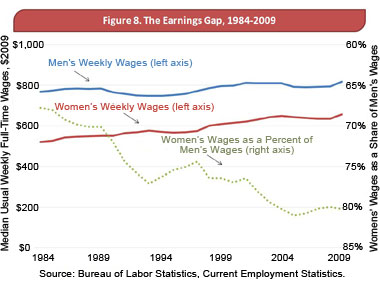
The AFL-CIO is calling for passage of the Paycheck Fairness Act to close the wage gap between men and women, a problem they say is increasingly urgent, with the above graph as Exhibit A. Get a load of that plummetting dotted gray line!
Now have a look at the right hand axis, which the perpetrators have conveniently drawn upside down for no apparent reason other than the obvious dishonest one.
I once wrote a book called More Sex is Safer Sex”. If you’re wondering what that means, you can read the essence of the argument in Chapter 12 of The Big Questions and/or watch me explain it on video.
Python programmer Jack Trainor has posted a simulation that he believes is somehow relevant to this argument. (Comments on his post are here.) I’d thought this was too nonsensical to respond to, but more than one reader has asked for a response, so here goes: Except for the fact that his code runs, Trainor’s managed to get this argument wrong in every possible way. He’s misstated the assumptions, he’s misstated the logic, and he’s misstated the conclusions.
Reminder: The Big Questions is out in paperback, and Amazon has it for 33% off. Do your Christmas shopping early!
This week we tackled the biggest of all questions: Why is there something rather than nothing? Then we tackled it again. If you like this stuff, you’ll like the opening chapters of The Big Questions .
In between, we paused for a few words about religion — another topic you’ll find a lot more about in The Big Questions.
I also told you where to find me in Memphis. I’ll see you there, or at least back here on Monday.
The paperback edition of The Big Questions goes on sale today — and Amazon has it for 33% off. This is a good time to stock up on gift copies for all your friends who are curious about math, physics, economics, philosophy or rational inquiry. Thanks to all of you for making this such a rewarding enterprise, and for the many blog comments that will make the next book even better.
Some quick words about the mathematical universe, which is the theme of the first chapter of The Big Questions:
1. A “mathematical object” consists of abstract entities (that is, “things” with no intrinsic properties) together with some relations among them. For example, the euclidean plane that you studied in high school geometry consists of points, together with certain relations among them (such as “points A, B and C are collinear”). Mathematical objects can be very complicated. Mathematical objects can have “substructures”, which is a fancy name for “parts”. A line in the plane, for example, is a substructure of the plane.
2. Every modern theory of physics says that our universe is a mathematical object, and that we are substructures of that object. Theories differ only with regard to which mathematical object we happen to be a part of. Particles, forces and energy are not just described by equations; they are the equations (together with abstract, purely mathematical relations among those equations).
According to a study by the Pew Forum on Religion and Public Life, forty-five percent of Americans Catholics are unaware that, according their own professed religion, the physical body of Jesus Christ tastes rather like a cracker. Protestants and Jews are equally ignorant of key facts about their own religions, though (at least according to the examples quoted in the New York Times) the gaps in their knowledge were less about theology and more about the roles of historical figures.
I can understand being simultaneously devout and a little hazy on religious history, but I don’t understand how you can be both devout and so hazy about the doctrines of your own church. In the words of Bryan Caplan, who blogged this first:
Memphis ain’t a bad town, for them that like city life.
And Memphis is where I will be later this month, for the sixth annual Economics Teaching Conference, where I will be one of three keynote speakers, along with Greg Mankiw and KimMarie McGoldrick. The conference runs all day Thursday, October 21 and Friday, October 22. To register, click here.
To understand the universe at the deepest level, we need to know not only how the universe behaves, but why.
Why is there something rather than nothing?
Why do we exist?
Why this particular set of laws and not some other?
So say Stephen Hawking and Leonard Mlodinow in their book The Grand Design, and so say I.
The Big Big Question is the first one: Why is there something rather than nothing? Hawking’s answer: The laws of physics — and especially the form of the law of gravity — allow for the spontaneous creation of universes out of nothing at all. We live in one of those spontaneously created universes. But this, of course, only serves to raise a new Big Big Question, namely: Why are the laws of physics as they are? Hawking’s answer: The laws of physics must be consistent and must predict finite results for the quantities we can measure. It turns out that those criteria pretty much dictate the form of the laws of physics.
So unless I’ve misunderstood him, here is Hawking’s position: In order for us to be able to measure the things that we measure, the laws of physics must have a certain form, and in order for them to have that form, universes must be able to arise from nothing. Therefore our universe was able to arise from nothing. But this does not seem to answer the question of why things couldn’t have been very different. Why couldn’t there have been no us, no measurements, no laws of physics and no anything?
I am traveling, my hotel has no wireless, and my ethernet adapter isn’t working.
So I have extremely limited net access and won’t be posting anything substantive today or tomorrow. I’ll be back Monday for sure.
PS—This means I’ll also be slower than usual re responding to comments, and that some comments might spend longer than usual in the moderation queue. I’ll do what I can toward checking in every now and then.
Some taxes are more painful than others. It’s not as simple as “the more you pay, the more it hurts”. Consider these two taxes, for example:
Tax A: Shoes are taxed at $0 per pair.
Tax B: Shoes are taxed at $100,000 per pair.
Under Tax A, everybody pays zero. Under Tax B, nobody buys shoes and everybody still pays zero. But Tax B is more painful, because it leaves us barefoot.
That’s of course an exceptionally simple example, but the same point arises in much subtler contexts. The pain caused by a tax is measured not just by what you pay, but also by what you do to avoid paying more.
At long last, I have video of the “Religion on Trial” debate between me and Dinesh D’Souza, held at FreedomFest 2010:
I was warned in advance that the audience would be hostile and that I had no hope of winning the final vote. This prediction proved entirely accurate.
Overall, I think we provided good entertainment without pretending that this was any kind of serious intellectual exercise. There are, of course, a few things I’d do differently given the chance, but I won’t indulge the temptation to enumerate them here. Enjoy the show.
You’re lost in a forest. What’s the best way to get out?
The great macroeconomist Bob Lucas once asked me this question, and I had no answer for him. I still don’t.
The assumption is that you know the size and shape of the forest, but you don’t know where you are or which way you’re facing. And the forest is so dense that you can never see any significant distance in front of you. What path should you follow?
A few years ago, billionaire David Koch donated $25 million to his alma mater, Deerfield Academy. From his presentation speech:
You might ask: How does David Koch happen to have the wealth to be so generous? Well, let me tell you a story. It all started when I was a little boy. One day, my father gave me an apple. I soon sold it for five dollars and bought two apples and sold them for ten. Then I bought four apples and sold them for twenty. Well, this went on day after day, week after week, month after month, year after year, until my father died and left me three hundred million dollars.
Now on the one hand I love this story. But wouldn’t it have been more plausible if he’d sold the first apple for, say, a nickel?
Well, maybe not much more plausible. Doubling your money every day, it takes just a little over a month to grow a nickel into three hundred million dollars.
The Big Questions is hosted by bluehost.com, and I’ve been thrilled with their service. Last night, through no fault of their own, the folks at bluehost were down for several hours (apparently a transformer blew out at an electrical plant down the street from them). As a result, the site was down for several hours and I never managed to get a post up for this morning. We’re back now, though.
Over the course of my childhood, I remember asking exactly one intelligent question. Unfortunately, I couldn’t make my parents understand what I was asking. Perhaps it was that frustration that deterred me from ever formulating an intelligent question again.
I was, I think, six years old at the time, and my question was this: If you’re traveling at 50 miles an hour at 1:00, and you’re traveling at 70 miles an hour at 2:00, must there be a time in between when you’re traveling exactly 60 miles an hour?
What made this question intelligent—and probably what made it incomprehensible to my parents—was that I was very keen to distinguish it from the question of whether your speedometer would have to pass through the 60-mile-an-hour mark. It seemed clear to me that the answer to that one was yes—that even if your true velocity could somehow skip directly from 50 to 70, the speedometer needle, in the course of whipping around from one reading to the other, would have to pass through the midpoint.
I quite vividly remember worrying that my question about your speed would be misinterpreted as a question about your speedometer, a question to which I thought the answer was obvious and therefore could only be asked by a very stupid person—a very stupid person for whom I did not wish to be mistaken. Therefore I prefaced the question with a long discourse on how it was thoroughly obvious to me that if your speedometer reads 50 miles an hour at one time and 70 miles an hour at another, then surely it must pass through 60 on the way, but that this was not not not not not the question I was about to ask, which concerned your actual speed and not the measurement thereof. By the time I got around to formulating the question itself, my parents (or at least my father; I don’t remember whether my mother was present) had quite understandably given up on figuring out what I was trying to get at.
A short followup to yesterday’s post on capital gains. This came up in the comments, and I think it’s worth highlighting:
Suppose we rewrite the tax code as follows: Every March 15, women pay 20% of their incomes and men pay nothing. Every April 15th, women pay 10% and men pay 20%.
Now someone writes a letter to the New Yorker complaining that the April tax is unfair to men, who pay twice as much as women do. I think it would be fair to dismiss this complaint as silly. Yes, it’s true that if you look at the April tax in isolation, men pay more than women. But there is no sensible reason to look at the April tax in isolation. If you look at the combined effect of the March and April taxes, women pay 30% and men pay 20%. By any sensible reckoning, women are taxed at a higher rate than men.
The New Yorker arrived today, leading off with this letter to the editor about income tax rates:
…The very rich pay at significantly lower rates, because most of their income consists not of compensation for services but of capital gains and dividends, which are capped at a fifteen per cent rate.
This is wrong, wrong, wrong, wrong, wrong, wrong, wrong, and you can’t begin to think clearly about tax policy if you don’t understand why. Even if capital gains taxes were capped at one percent, income subject to those taxes would be taxed at a higher rate than straight compensation. That’s because capital gains taxes (like all other taxes on capital income) are surtaxes, assessed over and above the tax on compensation.
It always pays to think through stylized examples. Alice and Bob each work a day and earn a dollar. Alice spends her dollar right away. Bob invests his dollar, waits for it to double, and then spends the resulting two dollars. Let’s see how the tax code affects them.
Back in 2003, I reported (here, here and in more detail here) that in disparate cultures around the world, from the U.S. to Kenya and from Mexico to Vietnam, parents of daughters are more likely to get divorced. This phenomenon, discovered by the economists Gordon Dahl and Enrico Moretti, is based on a sample size over 3 million and is therefore surely no coincidence.
After seven years, psychologist Anita Kelly, writing in Psychology Today (which might want to consider changing its name to Psychology Yesterday) has penned a response. She accurately summarizes the original argument:
Dahl and Moretti have summarized attempts to explain their facts as follows: Sons may either improve the quality of married life or worsen the pain of divorce (perhaps by becoming more distraught when the father leaves). Landsburg chooses the former explanation based on the fact that parents, on average, prefer having boys over having girls.