Our reader Jeff Poggi sent me a sonnet he wrote in honor of Darwin’s 200’th birthday, and kindly allowed me to reproduce it here. How many hidden Darwin references can you spot?
|
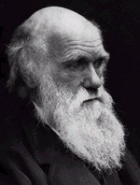 |

Our reader Jeff Poggi sent me a sonnet he wrote in honor of Darwin’s 200’th birthday, and kindly allowed me to reproduce it here. How many hidden Darwin references can you spot?
|
|

Data from 9,785 users of the dating site OKCupid reveal that iPhone users have 50% to 100% more sex partners than Android users, at every age.
This graph combines men and women, but the same pattern holds for each gender separately.
Explain this to me!
More info here (if you scroll down a couple of screens).
The Washington Post’s Ezra Klein had a great idea this week: He asked a bunch of economists and pundits to tell him where the Laffer curve bends. In other words, what is the marginal tax rate above which higher taxes lead to lower revenues? Meanwhile, coincidentally or not, Paul Krugman blogged on the very same question.
There’s a lot worth mentioning here, but let me start with one point that will be relevant below: Imposing a 20% income tax is not the same as cutting your wage by 20%. That’s because the income tax grabs not just a chunk of your current wages, but also a chunk of the future interest and dividends those wages enable you to earn. So a 20% income tax will, in general, discourage work more effectively than a 20% wage cut. This is important if you’re using data on wage cuts to predict the effects of income taxes.
That having been said, let’s see what we can learn from the responses:
Continue reading ‘Laffering All The Way’
The really big news from Hewlett Packard this week was not the dismissal of CEO James Hurd but the announcement by HP Labs researcher Vinay Deolalikar that he has settled the central question in theoretical computer science.
That central question is called the “P versus NP” problem, and for those who already know what that means, his claim (of course) is that P does not equal NP. For those who don’t already know what that means, “P versus NP” is a problem about the difficulty of solving problems. Here‘s a very rough and imprecise summary of the problem, glossing over every technicality.
Deolalikar’s paper is 102 pages long and less than about 48 hours old, so nobody has yet read it carefully. (This is a preliminary draft and Deolalikar promises a more polished version soon.) The consensus among the experts who have at least skimmed the paper seems to be that it is a) not crazy (which already puts it in the top 1% of papers that have addressed this question), b) teeming with creative ideas that are likely to have broad applications, and c) quite likely wrong.
As far as I’m aware, people are betting on point c) not because of anything they’ve seen in the paper, but because of the notorious difficulty of the problem.
And when I say betting, I really mean betting. Scott Aaronson, whose judgment on this kind of thing I’d trust as much as anyone’s, has publicly declared his intention to send Deolalikar a check for $200,000 if this paper turns out to be correct. Says Aaronson: “I’m dead serious—and I can afford it about as well as you’d think I can.” His purpose in making this offer?
Continue reading ‘P, NP and All That’
I rarely post in the middle of the day, but this seems to call for an immediate response:
Paul Krugman, feisty as ever, scoffs at the claim that public-sector employees are overcompensated. True, salaries are 13% higher in the public sector. But, says, Krugman, you’ve got to correct for the fact that public employees are (on average) better educated. After the correction, those public servants earn 4% less than the rest of us.
Well, Krugman is certainly right that you can’t take the raw data at face value. But, at least if you’re trying to be honest, you don’t get to pick and choose what you correct for either. Sure, let’s correct for education levels. Let’s also correct for the fact that public sector employees work fewer hours per week. And for differences in pension plans, and job security, and working conditions.
How can we ever be sure we’ve counted everything important? We can’t, as long as we do it Krugman’s way. So let’s do something sensible instead. Let’s look at quit rates. Quit rates in the public sector are about one third what they are elsewhere. In other words, government employees sure do seem to like holding on to their jobs. More than just about anyone else, in fact. Doesn’t that tell us everything we need to know about who’s overcompensated?
 How important is it to hire the best person for the job?
Here’s a data point: On Friday, Hewlett Packard’s CEO Mark Hurd resigned unexpectedly — and pretty much instantly the value of HP stock dropped by about $10 billion. If we assume Hurd would otherwise have been around for another 10 years or so, that means shareholders think his departure will cost the company about a billion dollars a year. Which, incidentally, makes his $30 million or so in annual compensation look like a hell of a bargain.
Now maybe some part of that $10 billion reflects expected short-term losses due to the turmoil of an unplanned transition. But even if that turmoil were to cost HP a full month of revenue (which seems like a pretty extreme assumption), that’s still less than a billion — leaving over $9 billion to represent the difference between what the market expected from Hurd and what it expects from his successor.
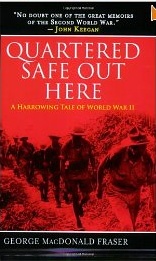 65 years ago today, the world changed. In his magnificent World War II memoir Quartered Safe Out Here, George McDonald Fraser looks back on what might have been:
I led Nine Section for a time; leading or not, I was part of it. They were my mates, and to them I was bound by ties of duty, loyalty and honor… Could I say, yes, Grandarse or Nick or Forster were expendable, and should have died rather than the victims of Hiroshima? No, never. And the same goes for every Indian, American, Australian, African, Chinese and other soldier whose life was on the line in August, 1945. So [I’d have said]: drop the bomb.
…
And then I have another thought.
You see, I have a feeling that if—and I know it’s an impossible if—but if, on that sunny August morning, Nine Section had known all that we know now of Hiroshima and Nagasaki, and could have been shown the effect of that bombing, and if some voice from on high had said: “There — that can end the war for you, if you want. But it doesn’t have to happen, the alternative is that the war, as you’ve known it, goes on to a normal victorious conclusion, which may take some time, and if the past is anything to go by, some of you won’t reach the end of the road. Anyway, Malaya’s down that way … it’s up to you”, I think I know what would have happened. They would have cried “Aw, fook that!”, with one voice, and then they would have sat about, snarling, and lapsed into silence, and then someone would have said heavily, “Aye, weel” and got to his feet, and been asked “W’eer th’ ‘ell you gan, then?”, and given no reply, and at last, the rest would have got up, too, gathering their gear with moaning and foul language and ill-tempered harking back to the long dirty bloody miles from the Imphal boxes to the Sittang Bend and the iniquity of having to do it again, slinging their rifles and bickering about who was to go on point, and “Ah’s aboot ‘ed it, me!” and “You, ye bugger, ye’re knackered afower ye start, you!”, and “We’ll a’ git killed!”, and then they would have been moving south. Because that is the kind of men they were.
Continue reading ’65 Years Later’
A U.S. District Court has overturned California’s Proposition 8 (the prohibition of same-sex marriage), which, says the court, violates both the Due Process and Equal Protection clauses of the Fourteenth Amendment. I am very happy to hear that the courts are open to overturning legislation that violates the Fourteenth Amendment. Next up, Title VII of the 1964 Civil Rights Act!
The issues are pretty much identical. Here is the District Court’s reasoning in the California case (this is the Court’s summary of the plaintiffs’ position, which the Court endorses):
Continue reading ‘Equal Protection’
| William Carlos Williams is a really bad roommate and I’m tired of sharing an apartment with him. | 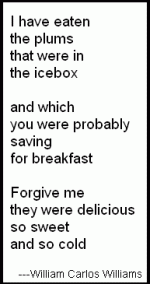 |
A hat tip to my buddy Rosa, with hat tips once and twice removed to Tim Pierce and Doctor Memory.
Yesterday’s post on deflation prompted a flurry of comments and emails remarking on how much economists disagree. This, I think, misses the point. Indeed, what I was trying to emphasize was that we all agree on the advantages of deflation as spelled out in Milton Friedman’s essay on The Optimum Quantity of Money. (I’ve put a quick summary of the key points here.) Therefore, the commentators who are currently worried about deflation must fall into two categories: First, there are the ignoramuses, of whom there are plenty on all sides of all issues. Second, there are those who are clearly not ignoramuses. Those in the latter camp have surely digested Friedman’s analysis, and understand the upside of deflation, but believe it is outweighed by some downside. It is frustrating to me that many of those commentators have failed to explain exactly what downside they have in mind.
Continue reading ‘Deflation Followup’
 So apparently we’re all supposed to be worried these days about the specter of deflation. I am doubly baffled by this—I don’t see the problem in theory and I don’t see the problem in practice. Maybe there’s something I’m missing.
Start with the theory: We learned long ago from Milton Friedman (who might have learned it from Irving Fisher) that a little bit of deflation is a good thing. That’s because deflation encourages people to hold money, and people who hold money aren’t buying stuff, and when other people don’t buy stuff, there’s more stuff left over for you and me.
There are a couple of other ways to see this, though they all come down to the same thing. Here’s the first: falling prices are good for buyers and bad for sellers, but that all washes out. It washes out in the aggregate because each gain to a buyer is offset by an equal and opposite loss to a seller. And it more or less washes out for each individual, because each of us sells roughly as much as we buy (including the sale of our labor.) But over and above all that, deflation enriches the holders of money, because their money increases in value as it sits around. That part is pretty much (may Milton’s ghost forgive me for putting it this way) a free lunch.
Continue reading ‘Deflating the Deflation Scare’
 We led off the week with a diversion that might have been premature in the sense that I can do more tricks now than I could then, and a bit more gracefully too, I think. More video when I feel ready to graduate to actual fire.
Next a post on the different kinds of logic, and a related post on what it all means.
Sadly, the latter continued to draw comments from readers who want to “define the natural numbers via axioms”, whereas the whole point of these posts is that nothing of the sort is possible.
On Thursday I took issue with Robin Hanson’s take on polygamy; Robin responds here.
And on Friday I pointed to an unconventional high school valedictory speech.
Note to RSS readers: Friday’s “high school” post was originally scheduled for Thursday. But when I read Robin’s polygamy post on Wednesday night, I wanted to respond to it, so I scheduled that post for Thursday and rescheduled the high school post for Friday. For some reason the rescheduling didn’t take, so that the high school post was briefly posted Thursday morning before I realized what had happened and took it down. By then, though, the RSS feeds had it. So that’s why many of you saw the same post two days in a row.
Back on Monday of course.
High school valedictorian Erica Goldson explains the secret of her success:
I have successfully shown that I was the best slave. I did what I was told to the extreme. While others sat in class and doodled to later become great artists, I sat in class to take notes and become a great test-taker. While others would come to class without their homework done because they were reading about an interest of theirs, I never missed an assignment. While others were creating music and writing lyrics, I decided to do extra credit, even though I never needed it.
This is from her valedictory address to her fellow graduates; you can read the entire speech on her blog.
What do you think?
One argument that’s often made against legalized polygamy is that rich old men will marry lots of women, leaving lots of poor young men both single and sexually frustrated—-and that’s bad, because poor young single sexually frustrated men are prone to criminal acts of violence.
Over at Overcoming Bias, Robin Hanson objects that if people really believed this argument, they’d want to criminalize lesbianism and extramarital affairs, both of which also contribute to the problem of men-without-partners.
Continue reading ‘More Wives are Unsafe Wives?’
 Yesterday I answered one of Coupon Clipper‘s questions about Godel’s Theorem. Today I’ll tackle the other: Does Godel’s Theorem matter on a day-to-day basis to practicing mathematicians?
And the answer is: Of course not. Mathematicians care about what’s true, not about what’s provable from some arbitrary set of axioms. (Of course this is an overgeneralization; some mathematicians have built distinguished careers on worrying about what’s provable from various sets of axioms. But they are a small minority.) Godel’s Theorem says that not all true things are provable. But for the most part, we’re happy just to know they’re true.
The flashiest example I can give you—and one I’ve used on this blog before—is Fermat’s Last Theorem, which says that no equation of the form xn + yn = zn has any solutions, as long as n is at least 3 and x, y and z are non-zero. Proving this was the was most famous unsolved problem in mathematics for 350 years until it was solved (to much public fanfare) by Frey, Serre, Ribet and Wiles in the 1980’s and 1990’s.
We know from that work that Fermat’s Last Theorem is true. However, we still don’t know whether Fermat’s Last Theorem follows from the standard axioms for arithmetic. And—this is the point—very few mathematicians care very much, at least by comparison to how much they care about the theorem itself. (Here is one of my favorite papers on the subject. Tellingly, the author is a philosopher.)
Continue reading ‘Godel, Fermat, Hercules’
The occasional commenter who goes by the name Coupon Clipper has emailed me some interesting questions about Godel’s Theorem. I think I’ll answer them here.
The first question is about first-order versus second-order logic, so let me explain the distinction. When we reason formally about arithmetic, we need to clearly specify the ground rules. This means, among other things, specifying the language and grammar we’re allowed to use. A very simple language might allow us to say things like “2 + 3 = 5” or “8 is an even number”. With a language like that, you could talk about a lot of sixth grade arithmetic, but you wouldn’t be able to say anything very interesting beyond that. To talk about the questions mathematicians care about, you need a language that contains words like “every”, as in Every number can be factored into primes or Every number can be written as a sum of four squares or Every choice of positiive numbers x, y, and z will yield a non-solution to the equation x3+y3=z3 . That language is called first-order logic.
With first order logic we can specify a set of axioms, and then follow a prescribed set of rules to deduce consequences. For example, if you’ve already established that every number is a sum of four squares, then you’re allowed to conclude that 1,245,783 is a sum of four squares. (The general rule is that if you’ve proved that every number has some particular property, then you’re allowed to conclude that any particular number has that property.)
Continue reading ‘First Things and Second Things’
 Before we get to the roundup, here’s the latest chapter in the ongoing intellectual suicide of Paul Krugman:
advocates of austerity have been using Canada in the mid-90s as an example of a success story; surely they can’t have it both ways.
The problem, of course, is that there is no “they” who are trying to have it both ways. Reinhart and Rogoff have made an argument about Canada in the 90’s. That argument stands or falls on its own. It is no refutation to observe that somebody else might have made some other (correct or incorrect) argument about Canada in the 90’s.
Continue reading ‘Weekend Roundup’
Yesterday’s pop quiz posed this question:
Suppose that an acre of land in Iowa can yield either 50 bushels of wheat or 100 bushels of corn, while an acre of land in Oklahoma can yield either 20 bushels of wheat or 30 bushels of corn.
Which state has the comparative advantage in growing wheat? Which state has the comparative advantage in growing corn?
Suppose the residents of each state consume 200 bushels of wheat and 360 bushels of corn. If, instead of pursuing policies of self-sufficiency, each state specializes in its area of comparative advantage, how many acres of Iowa and Oklahoma farmland are freed up for other uses?
Quite a few people got this right in comments. In Iowa, the opportunity cost of a bushel of wheat is 2 bushels of corn. In Oklahoma, the opportunity cost of a bushel of wheat is 3/2 bushels of corn. Becauses 3/2 is less than 2, Oklahoma is the low-cost wheat producer, which is the same thing as saying that Oklahoma has the comparative advantage in wheat.
Continue reading ‘Pop Answers’
Commenting on this essay by former Intel chief Andy Grove, Tyler Cowen writes that “Only he who first shows he understands comparative advantage has license to partially reject it.”
Hear hear. When someone says “I understand comparative advantage, but in this case it doesn’t apply”, or “I understand comparative advantage but in this case it is overridden by other considerations”, my experience tells me that you can be nearly sure you’re talking to someone who does not in fact understand comparative advantage.
If you haven’t seen this, you should see it. You don’t need to know or care much about baseball to be delighted. It’s the bottom of the eighth, tie score, bases loaded.
Stop me if you’ve heard this one. A subject (called the proposer) is placed in an isolation booth and given ten dollars to divide between himself and the stranger in the booth next door. The stranger (called the responder) can accept or reject the division. If he accepts, they each take their shares and go home. If he rejects, they each go home with nothing.
In experimental plays of this ultimatum game, responders tend to reject splits that are substantially worse than 50-50. This is offered as some kind of reproof to the principles of economics. After all, the responder is turning down free money.
But so what? Continue reading ‘Ultimately Simple’
Okay, if Paul Krugman is going to keep on writing the same column twice a week every week forever, then I am going to keeping on objecting to it forever, though not, I promise, twice every week.
A couple of bullet points from his latest:
Somehow we’ve gone a month since the last weekend roundup. So this will reach back a little further than usual in time.
Riddles. We tackled some riddles: Why do guys with deep pockets take on risky ventures instead of selling them off to someone with nothing to lose? Why, when a plane headed for Atlanta is diverted to Greenville, does everyone else choose to stand for an hour at the ticket counter while I (and only I) saunter over to the Hertz counter and grab one of many available cars? And why does Jet Blue, after investing $800 million in its new terminal at JFK, choose to make that terminal so hellish a place that I for one will never travel through it again if I can possibly avoid it?
Paul Krugman. Yes, I know, I can’t seem to let this topic go. I was at it here, and then here, and here and finally here.
Let me summarize my complaint in a paragraph: Krugman has some policies he’d like to see enacted. Some people oppose those policies for silly reasons and others oppose them for sensible reasons. Krugman habitually ridicules the silly reasons and pretends that he has therefore dispensed with the sensible reasons.
More specifically, Krugman attacks “deficit hawks” but ignores the “spending hawks” who present a much stronger case for fiscal restraint. He’s right to attack the deficit hawks, who make the silly mistake of conflating spending (which is costly) with tax cuts (which are not)—but then he makes the same mistake himself when it suits his purposes.
Incidentally, my Toy Stories post contains a link to a toy model intended to highlight the key questions that Krugman willfully ignores. At the end of that post I added an addendum confessing to arithmetic errors in the model and inviting readers to correct them. On a second reading, I realized there are no arithmetic errors—just one typo in an equation. Because some comments refer to that typo, I’ve chosen not to correct it, but it’s explained in the current addendum to the original post.
Books. Our book posts covered everything from the ridiculous to the sublime to the magnificent.
Math. The music of the primes gives a glimpse of the glorious intricacy of arithmetic, and our post on Fermat’s Last Theorem gives a small taste of how to tackle a particularly vexing problem.
Videos We had videos on cruel and unusual punishment, on the end of racism, and on how to fix everything.
Miscellaneous. Can Mike Huckabee possibly believe the things he says about religion? Does anyone still subscribe to the superstition of dollar cost averaging? And why the disproportionate outrage about an oil spill in the Gulf when there’s so much more to be outraged about?
Okay, we’re more or less caught up now! See you Monday.
 I’ve just finished reading The Girl Who Played with Fire, the second book in the series that begins with The Girl with the Dragon Tattoo. I’m not giving away any significant plot point when I tell you that there’s a character who works on Fermat’s Last Theorem as a hobby, or that the book was clearly written (or perhaps translated) by somebody with no clue how mathematics works or what Fermat’s Last Theorem is about. I particularly liked the reference to Andrew Wiles using the “world’s most complicated computer program” to solve the problem. It’s my understanding that Andrew barely even uses email. And certainly if you understood anything about the nature of the problem and/or the solution, you’d recognize the absurdity of trying to tackle it with a complicated computer program.
Be that as it may, I finished the novel with a few hours left to spare, so of course I was inspired to work on Fermat’s Last Theorem, or at least on the simplest cases. The problem, if you’ll recall, is to show that there are no integer solutions to any of the equations x3+y3=z3 , x4+y4=z4 and so on, except for the so-called trivial solutions in which one or more variables take the value zero.
Continue reading ‘The Girl Who Played With Numbers’
I was delighted last month to learn that racism in America has been thoroughly vanquished, as evidenced by the NAACP’s having nothing better to do than complain about a greeting card that shows cartoon characters encountering black holes as they hurtle through space. (“It’s very demeaning to African American women”. See if you can guess why, then watch the video below to check your answer.)
I realize that some will criticize the NAACP for over-reacting here, or for mis-reacting. But cut them a break. You don’t see them doing anything truly loonytunes, like, say, commanding the amorphous Tea Party movement to “expel the bigots and racists in your ranks or take full responsibility for all of their actions.” Right?
A hat tip to our frequent commenter Ken B. for pointing me to the video.
 Over at Marginal Revolution, Tyler Cowen puzzles over Ian Ayres‘s take on investment strategy:
In our risk-reducing implementation, we want people to borrow to invest more when young and then invest less when older. The lifetime exposure to stocks is held constant. Compare the following two investment paths:
Option 1:
- Year 1 Invest $1
- Year 2 Invest $2
- Year 3 Invest $3
Option 2:
- Year 1 Invest $2
- Year 2 Invest $2
- Year 3 Invest $2
Our view is that option 2 is the safer bet.
(Note that when Ayres says “invest $2” he does not mean “Add $2 to your investment”. He means “Have a total of $2 invested.” So under Option 1 you add a dollar a year to your investment. Under Option 2 you do all your investment up front and then scoop out all the profits every year (or scoop replacement funds in if you’ve taken losses). Option 1, in other words, is the widely touted but thoroughly ridiculous strategy often called Dollar Cost Averaging.
Continue reading ‘Eggs and Baskets’
 Is there a name for this phenomenon? A firm sinks vast resources into an immensely complicated engineering project and gets most of it right, but gets one detail so glaringly wrong that it seems like they might just as well not have bothered. Lexus and Jet Blue come to mind.
Continue reading ‘All in the Details’
After several days in 105 degree desert heat, followed by 12 hours of travel, I think I am going to collapse now rather than blog. If all goes according to plan, I’ll be back with something substantive Tuesday morning.
 I’m off to Las Vegas and FreedomFest, where I’ll be speaking (probably) on why More Sex is Safer Sex, and debating Dinesh D’Souza in a specatacle billed as Religion on Trial. The religion debate will take place Friday July 9 at 5PM at Bally’s Casino and we expect it to be carried on both C-Span and C-Span 2, though I’m unclear on whether the coverage will be live. (Quite possibly it depends on what else that’s newsworthy is going on.)
All of which is my excuse for taking the rest of the week off from blogging. I’ll see you next week, and I’ll let you know how things went.